
How Much Does Spray Foam Insulation Cost in Canyon Lake?
Our Spray Foam Insulation services in Canyon Lake, TX typically cost between $1.50 and $4.50 per board foot, depending on foam type, application area, and the thickness required to meet Texas energy code. For a full attic air-sealing and spray foam job in a 1,800-2,400 sq ft Canyon Lake home, most homeowners pay somewhere between $2,800 and $7,500. Open-cell foam lands at the lower end; closed-cell foam, which performs better in the high-humidity conditions this region sees between May and September, sits at the higher end.
Before any number means anything, though, the air leaks have to be found and sealed first. At Spray Foam Insulation in Canyon Lake, we walk through what that process actually looks like for local homes.
Spray Foam Insulation Cost Breakdown (2026)
Spray foam pricing in Canyon Lake, TX breaks down by foam type, application location, and board-foot volume. A board foot is one square foot of surface covered at one inch of thickness – so a 500 sq ft attic floor sprayed at 2 inches equals 1,000 board feet. The table below reflects what we see in the Canyon Lake market as of 2026, including the Hill Country heat load and the periodic humidity spikes that make air sealing a technical requirement rather than a sales pitch.
| Application | Foam Type | Typical Thickness | Cost Range (per board foot) | Estimated Job Cost (avg. Canyon Lake home) |
|---|---|---|---|---|
| Attic floor / top plates | Open-cell | 3-5 inches | $0.44-$0.65 | $1,200-$2,800 |
| Attic floor / top plates | Closed-cell | 2-3 inches | $1.00-$1.50 | $2,100-$4,200 |
| Roofline / rafters (unvented attic) | Open-cell | 5-7 inches | $0.44-$0.65 | $2,800-$5,200 |
| Roofline / rafters (unvented attic) | Closed-cell | 3-4 inches | $1.00-$1.50 | $3,800-$7,500 |
| Rim joists / crawl space walls | Closed-cell | 2 inches | $1.00-$1.50 | $600-$1,400 |
| Interior wall cavities | Open-cell | 3.5 inches (cavity fill) | $0.44-$0.65 | $1,800-$3,500 |
| Garage ceiling / bonus room floor | Closed-cell | 2-3 inches | $1.00-$1.50 | $900-$2,200 |
These ranges include materials and labor but do not include old insulation removal if the attic already has a degraded fiberglass batt or blown-in layer that needs to come out first. Removal in Canyon Lake typically adds $0.75-$1.25 per sq ft of attic floor. Air sealing – top plates, can lights, plumbing penetrations, and electrical chases – is priced separately and usually runs $400-$900 on a standard single-story Canyon Lake home before any foam goes in. Under the Haven Standard, that air-sealing scope is completed before insulation is ever added. We do not spray foam over unsealed penetrations.
What moves a job toward the high end of those ranges: vaulted or cathedral ceilings that require scaffolding, attics with steeper-than-average pitches common to some of the newer construction near FM 2673, homes with extensive HVAC ductwork penetrating the ceiling plane, and projects where the homeowner wants an unvented attic assembly – which brings the HVAC equipment inside the conditioned envelope and typically cuts duct-loss energy waste by 20-30 percent, but requires more foam at the roofline.
What Affects Spray Foam Insulation Pricing in Canyon Lake
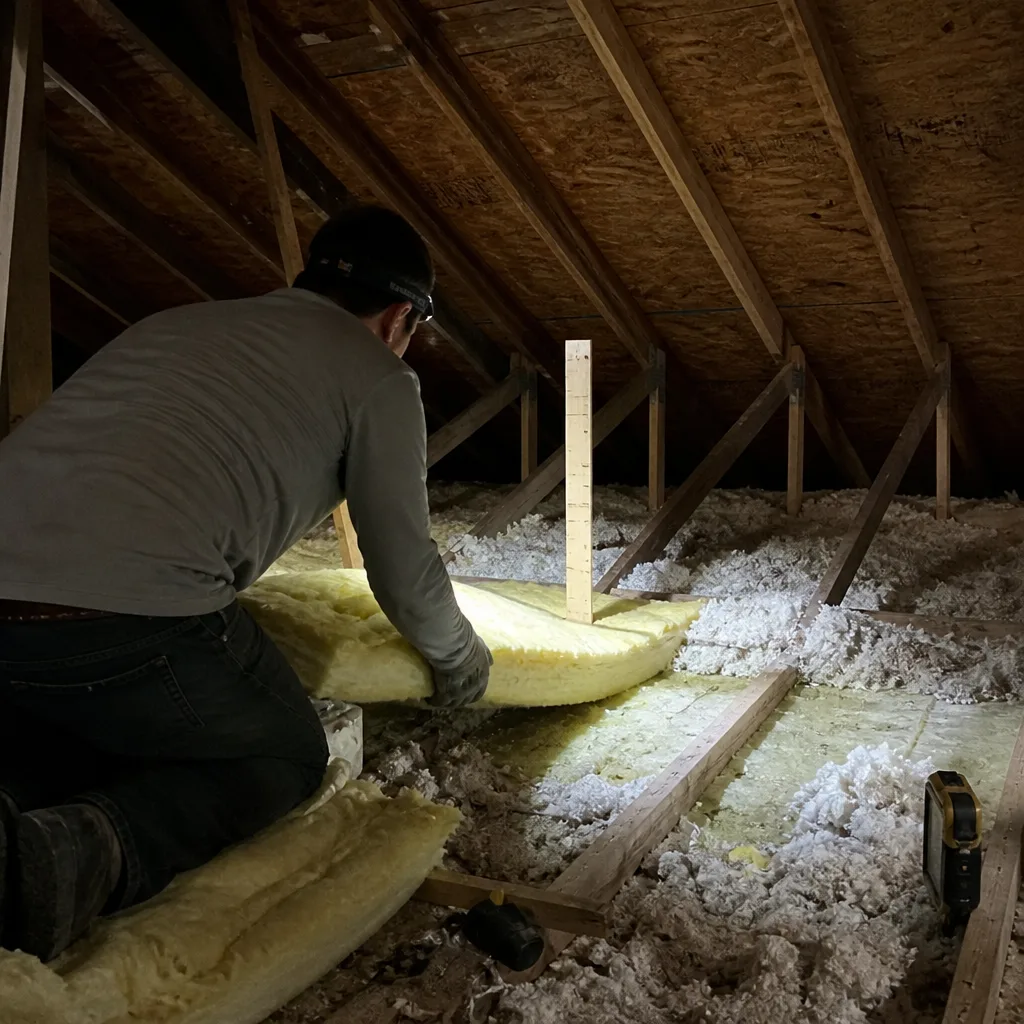
- Foam type: open-cell vs. closed-cell. Open-cell foam (roughly $0.44-$0.65/board foot) is vapor-permeable, expands to fill cavities thoroughly, and handles sound attenuation well. Closed-cell foam ($1.00-$1.50/board foot) adds structural rigidity, has a higher R-value per inch (about R-6.5 vs. R-3.7), and is the right call for rooflines and rim joists in Canyon Lake where bulk water and condensation are real seasonal concerns. The choice is not cosmetic – it is a technical decision based on where the foam goes and what it needs to resist.
- Application location and access difficulty. An open attic floor with easy hatch access costs less to spray than a fully framed roofline or a crawl space with limited clearance. Some of the lakefront properties on Canyon Lake’s north shore have pier-and-beam foundations with under-two-foot clearances – that adds time and therefore cost to any crawl space work.
- Required R-value and thickness. Texas Energy Code (IECC 2021, which Comal County follows) requires attic insulation at R-38 minimum for Climate Zone 2, which Canyon Lake sits in. Achieving R-38 with closed-cell foam requires approximately 5.5-6 inches; with open-cell foam, you need 10+ inches. Thicker application means more material and longer spray time – both move the price up.
- Existing insulation condition and removal needs. Homes built in the early 2000s near White Wing Cove or Jacobs Creek that still have their original fiberglass batts often show significant settling, rodent disturbance, or moisture staining. Removing that material before spraying adds cost but is the only way to get an honest blower-door reading afterward. Spraying over compromised insulation does not fix the air leaks underneath it – it just buries them.
- Canyon Lake’s climate load and humidity cycles. Canyon Lake sits at roughly 950 feet of elevation in the Texas Hill Country, and the Guadalupe River corridor creates localized humidity swings that flat-city markets do not see as severely. Between April and October, attic spaces here regularly hit 140-160°F on south-facing roof decks, and relative humidity can spike overnight after a front. That combination accelerates the degradation of open-cell foam in unprotected roofline applications – which is why closed-cell is usually the technically correct answer for any above-deck application here, even though it costs more.
- Project scope: spot treatment vs. whole-envelope. Spraying only the rim joists in a basement or crawl space is a small job. Converting a vented attic to an unvented assembly for a 2,600 sq ft home near Cranes Mill Road is a full-day, multi-person job. Volume discounts are real – the per-board-foot cost comes down when the project is large enough to justify a full drum kit and extended spray time. On a written estimate from us, you will see this as a line item, not buried in a lump sum.
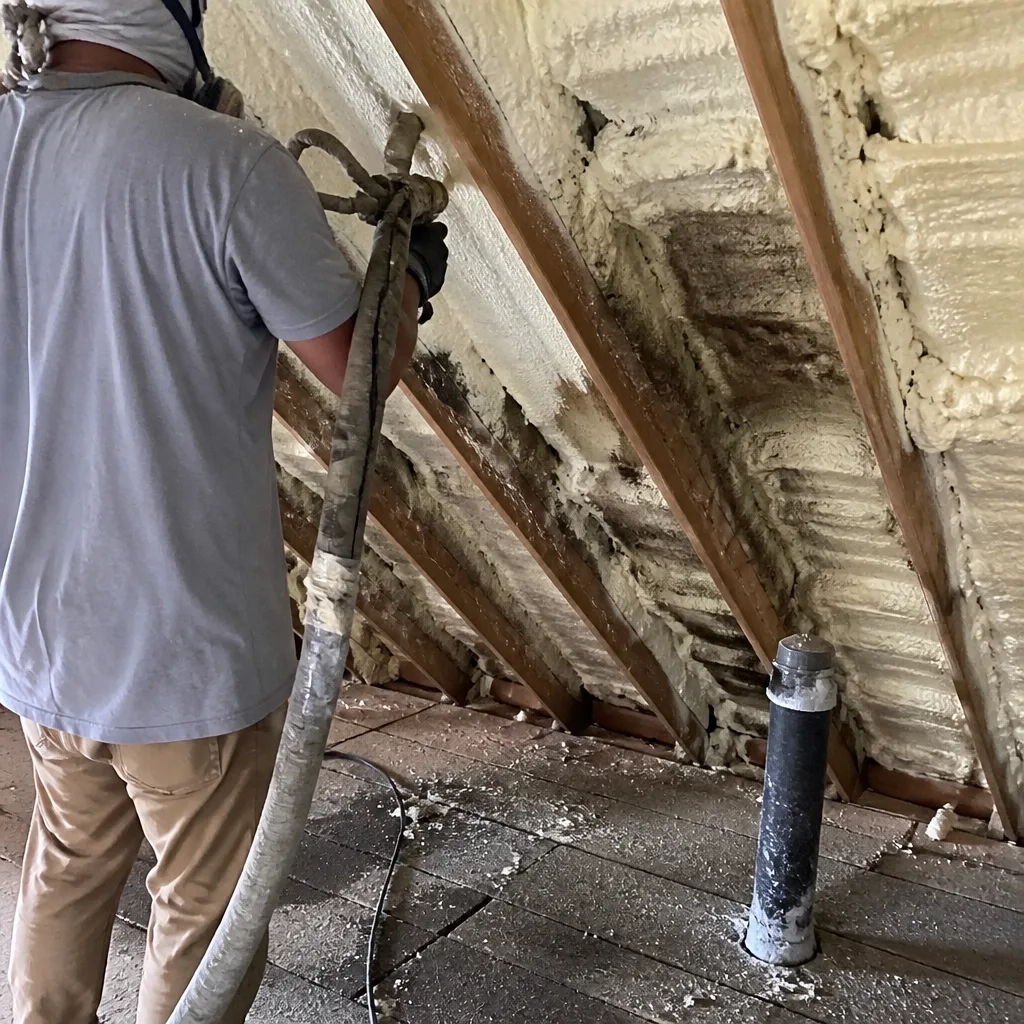 Before
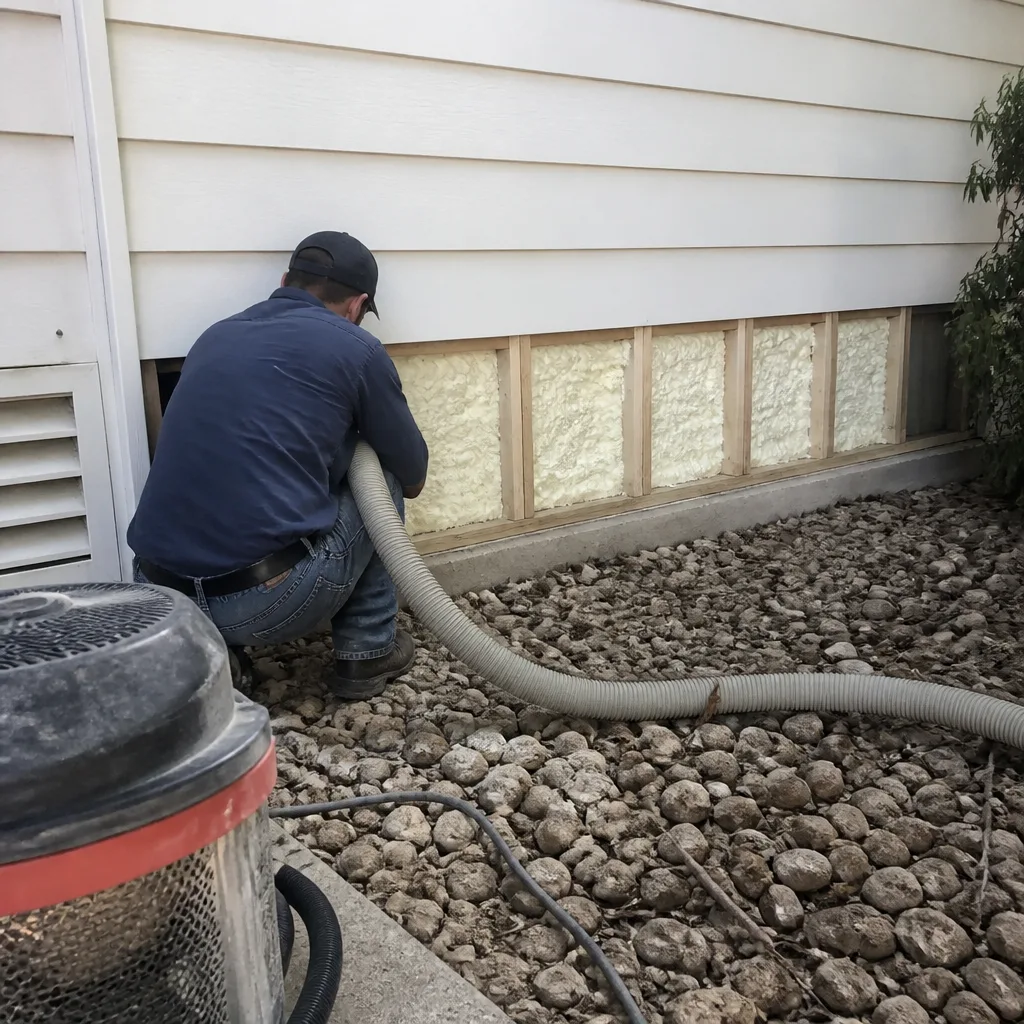 After
AfterOpen-Cell vs. Closed-Cell Foam: Which One for Canyon Lake?
This comes up on nearly every estimate we write in Canyon Lake. The short answer: closed-cell for rooflines, rim joists, and any surface exposed to outdoor air or potential moisture. Open-cell for interior wall cavities and attic floors where vapor-permeability is acceptable and budget is a factor.
Open-cell foam is about half the cost per board foot and is effective for air sealing at typical interior locations. It’s also softer, easier to trim, and better at filling irregular framing cavities common in the custom and semi-custom homes you see throughout the Mystic Shores subdivision and along the newer developments off FM 306. The downside: it absorbs moisture. In a roofline application facing a humid Texas summer, open-cell foam can hold enough water vapor to eventually cause sheathing damage. That is not a theoretical risk in this climate – it is a documented failure mode.
Closed-cell foam, sourced from manufacturers like Icynene and Demilec, creates a rigid, vapor-impermeable layer that also adds measurable racking strength to wall and roof assemblies. R-6.5 per inch means you hit code minimums at far less thickness, which matters in shallow rafter bays. The cost premium is real, but so is the performance difference.
On every estimate we write, we specify which foam type is recommended for each application zone and explain why. Under Haven Standard Clause 1, that written scope is in your hands before anyone mixes a drum.
The Air Sealing Step Canyon Lake Homeowners Often Miss
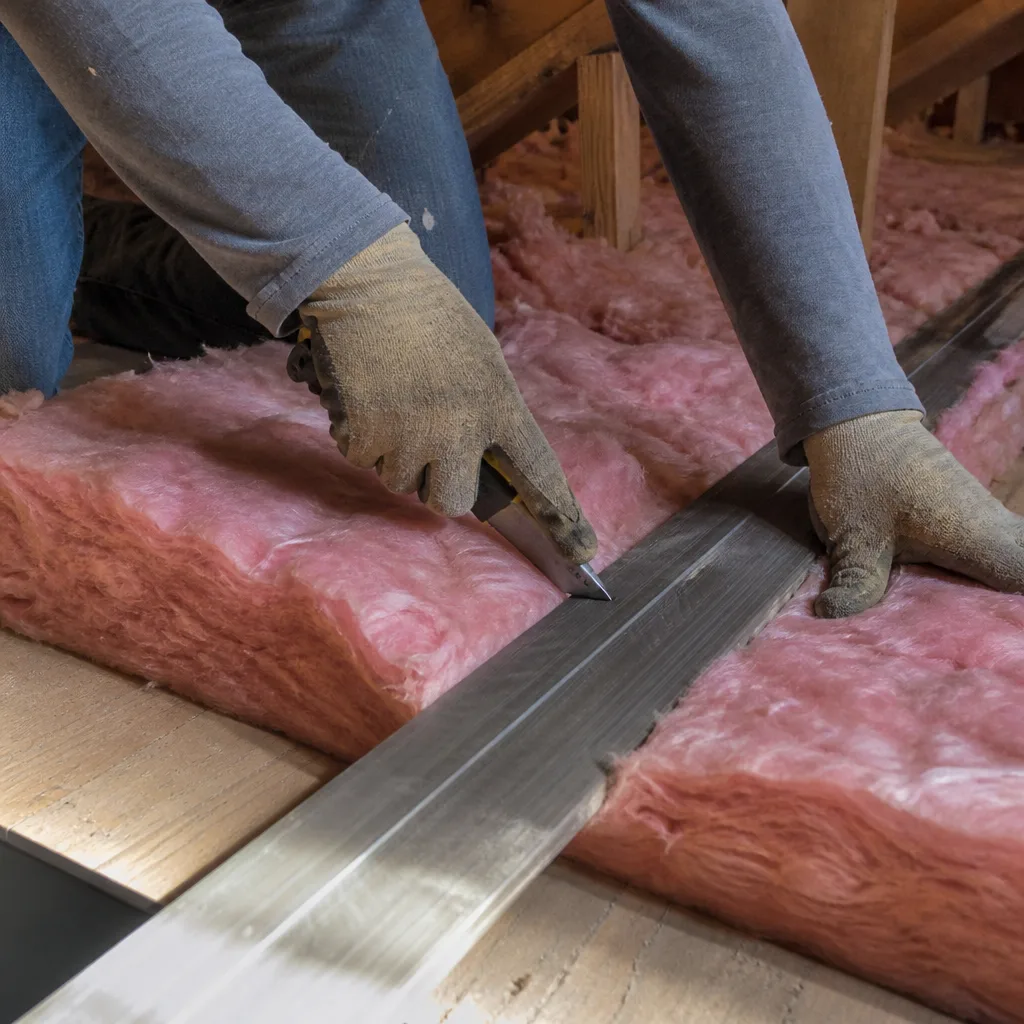
Adding R-38 of spray foam to an attic that still has open top plates, unbooted can lights, and un-caulked plumbing penetrations is like insulating around open windows. The thermal resistance is there on paper; the energy savings are not. We see this on blower-door tests regularly in Canyon Lake homes that had insulation added without air sealing – the CFM50 number barely moves even though the attic looks well-insulated.
A blower-door test measures the total air leakage of a home at 50 pascals of pressure – one number, in cubic feet per minute, that tells you how much conditioned air the building envelope is losing. A Canyon Lake home that reads 4,800 CFM50 before air sealing and 2,600 CFM50 after is a 46 percent reduction in air leakage, and that change shows up on the electric bill starting the next month.
At Envelope Insulation Co., air sealing is a prerequisite, not an upsell. Every attic job includes the sealing of top plates, can-light penetrations, and plumbing and electrical chases before spray foam is applied. We publish before-and-after blower-door readings on every applicable job. If a contractor quotes you spray foam without mentioning air sealing or a blower-door test, ask them why. The answer will tell you something about how they approach the work.
For a broader picture of what our building envelope work covers, the home page lays out every service we provide in this market.
How to Save on Spray Foam Insulation in Canyon Lake
Spray foam is not the cheapest insulation product per board foot, and honest pricing advice does not pretend otherwise. But the question is not always what costs least at installation – it is what delivers the best return over time in Canyon Lake’s climate. That said, here is where real savings can be found:
- Combine projects when possible. If you are already having spray foam applied to the roofline, adding rim joist sealing at the same visit costs a fraction of what a return trip would. Equipment is set up, technician is on site, foam is mixed. Ask for both scopes on the same estimate.
- Get a second opinion on any written estimate. Under our Haven Standard, we offer a free second opinion on any written estimate – bring us a competitor’s quote and we will read it with you line by line. This is not a sales tactic; it is how we make sure you understand what you are being quoted for. Price differences between contractors often come down to scope differences, not actual savings.
- Check for utility rebates before the job starts. New Braunfels Utilities and some other Comal County-adjacent providers have offered rebates for qualifying insulation upgrades. Amounts and eligibility change year to year, but a $200-$400 rebate on a qualifying project is worth 10 minutes of research before anyone starts work.
- Time the project outside peak summer months. Canyon Lake contractors – including us – tend to have tighter schedules between June and August when emergency calls and new construction tie up crews. Scheduling in late winter or early spring (February through April) often results in faster scheduling and, in some cases, more flexibility on project timing.
- Don’t skip the air sealing to reduce cost. This one works against you. A homeowner who cuts the air-sealing scope to save $600 upfront and then pays for that decision in electric bills over three summers has not saved money. The math is not close. Air sealing and spray foam work together as a system – one without the other is an incomplete envelope.
- Know what you are buying before you sign anything. A written price, a written scope, and a written warranty before work starts are baseline expectations – not bonuses. If a contractor will not put those three things in writing before beginning, that is relevant information.
For an exact number based on your home’s actual square footage and attic configuration, call (737) 227-6219. Estimates are free, written, and come with a full scope description before any work is scheduled.
What Canyon Lake Homeowners Actually Get After the Job
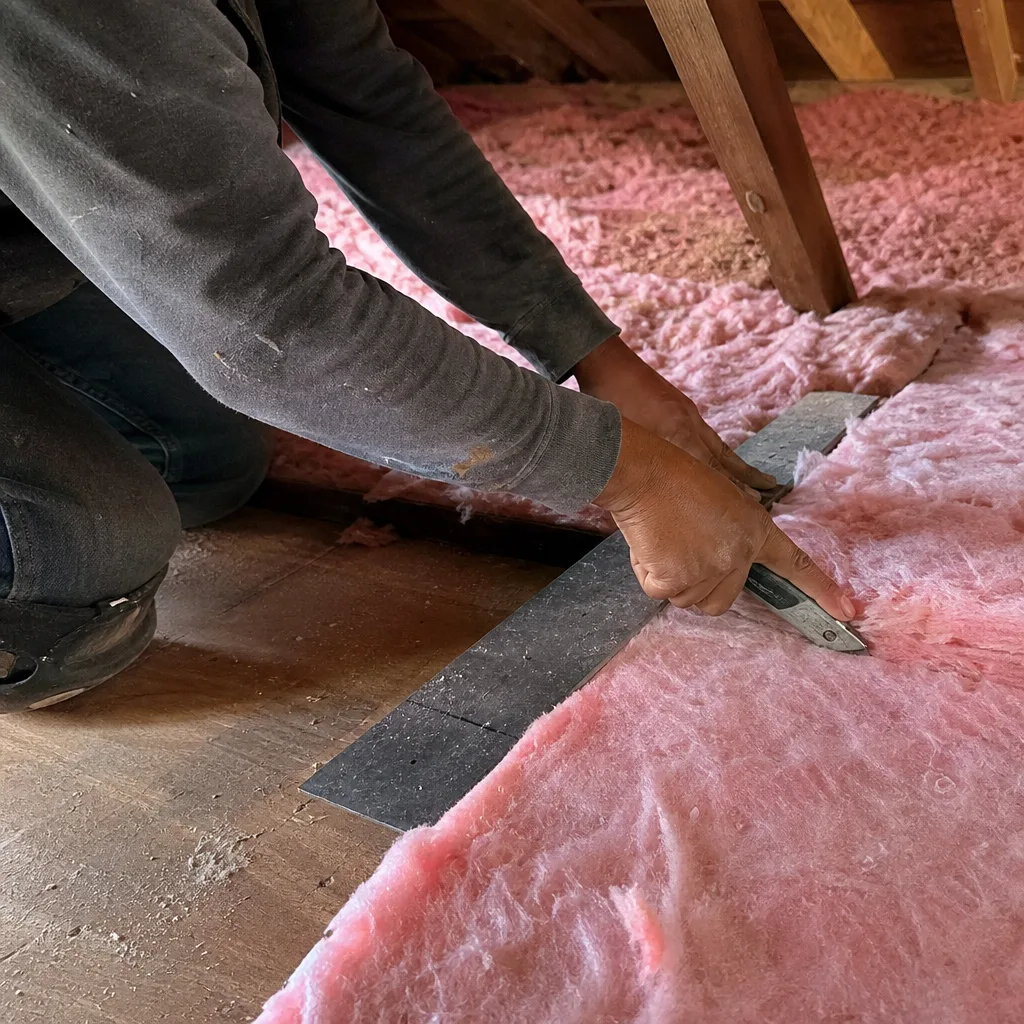
This is worth being specific about, because “we do great work” is what every contractor says and none of it can be verified after the fact without documentation.
Every Envelope Insulation Co. job in Canyon Lake closes with:
- A Documented Photo Record – photos of the attic, the penetrations sealed, the spray foam applied, and any problem areas found during the walkthrough. These are provided to the homeowner, not stored internally as an afterthought.
- Before-and-after blower-door readings on every applicable job – a pressurization test that produces a single CFM50 number before the work and another after. The difference is the measurable air-sealing result. On a Canyon Lake home we completed near Rebecca Creek Road in 2024, the blower-door reading dropped from 5,100 CFM50 to 2,650 CFM50 after sealing and spray foam – a 48 percent reduction in air leakage.
- A written warranty delivered before work starts, not handed over at the end when the leverage is gone.
- The 365-Day Done Right Promise: if something is not right within the first year, we fix it. That is not conditional on what caused the issue – it means we stand behind the scope we wrote and signed.
9,000+ homes have been sealed and insulated by Envelope Insulation Co. since 2016, every one with a written price before work started and a documented record when the crew left. That number is not a marketing figure – it is the count of jobs where those two requirements were met without exception.
Permit and Code Requirements for Spray Foam in Canyon Lake, TX
Canyon Lake is an unincorporated community within Comal County. Most residential insulation work in Canyon Lake does not require a pulled permit, but this depends on the scope of the work and whether it is connected to a larger remodeling project that does require a permit. If spray foam is being added as part of a reroofing or HVAC replacement that involves a permit, the insulation must meet IECC 2021 standards for Climate Zone 2 – R-38 minimum for attic assemblies, R-13 for exterior walls, and R-10 or R-5+R-13 for below-grade or crawl space walls.
If you are in a newer development near Mystic Shores, Cranes Mill, or any HOA-governed community, check whether your HOA has inspection requirements for work performed in the attic or on the building envelope. A few HOAs in Comal County have added language requiring contractor documentation for any work affecting fire-rated assemblies, which can apply to closed-cell foam in attached garage ceilings.
We handle the technical specification questions as part of every estimate. You will know what code requires, what we are installing, and why before any foam is mixed.
FAQs: Spray Foam Insulation Cost in Canyon Lake, TX
How much does spray foam insulation cost per square foot in Canyon Lake?
Spray foam insulation in Canyon Lake runs $1.50-$4.50 per board foot, which translates to roughly $3.00-$9.00 per square foot at typical installation thicknesses. Open-cell foam applied at 3.5 inches (one board foot per square foot of coverage at 3.5 inches thick equals 3.5 board feet) to an attic floor costs closer to $1.50-$2.25 per square foot of surface area. Closed-cell applied at 3 inches to a roofline runs $3.00-$4.50 per square foot of surface area. For an exact number based on your attic dimensions and foam type, call (737) 227-6219 for a free written estimate.
Is spray foam worth the cost compared to blown-in insulation in Canyon Lake?
For roofline applications and rim joists in Canyon Lake, closed-cell spray foam outperforms blown-in fiberglass or cellulose because it air-seals and insulates in one step. Blown-in insulation adds R-value but does not seal penetrations – you still need a separate air-sealing pass. For a flat attic floor where R-38 is the target, blown-in cellulose at $0.85-$1.40 per sq ft plus $400-$900 in air sealing can reach the same performance outcome for significantly less than spray foam. The right answer depends on the application location – and that is exactly the kind of line-item comparison a written estimate should show you.
How long does spray foam insulation last in a Canyon Lake home?
Properly applied closed-cell spray foam has a functional lifespan of 20-30+ years in a Canyon Lake attic. Open-cell foam in protected interior applications (wall cavities, attic floors) similarly holds its performance for decades when it stays dry. The risk zone is open-cell foam in roofline or exterior applications where sustained moisture exposure can cause performance degradation within 5-10 years. In Canyon Lake’s Hill Country climate, this is a real concern between May and September – which is why closed-cell is the technically correct product for any above-deck or exterior-facing application here.
Can spray foam insulation lower my energy bills in Canyon Lake?
In Canyon Lake, most homes see a 15-30 percent reduction in cooling costs after a full attic air-sealing and spray foam upgrade. The variation depends on the home’s baseline leakage rate – a house that was losing 5,000+ CFM50 before sealing has more room to improve than one that was already tight. The only way to know the actual reduction is a blower-door test before and after, which is why we run one on every applicable job and provide the numbers in writing. A Canyon Lake home that drops from 4,800 CFM50 to 2,400 CFM50 is cutting its air leakage in half, and in Climate Zone 2 with summers averaging 95°F+, that is not a small change on the utility bill.
How do I get an accurate spray foam insulation quote in Canyon Lake?
An accurate quote requires a physical walkthrough – attic square footage pulled from a floor plan estimate is not reliable enough to price spray foam because rafter pitch, penetration density, existing insulation condition, and access points all affect scope and labor. At Envelope Insulation Co., we provide a written, flat-price quote with a full scope description before any work is scheduled – no vague per-job estimates, no “it depends” pricing that changes after the crew arrives. Call (737) 227-6219 to schedule a free estimate.
Does spray foam insulation require air sealing too?
Spray foam applied to a roofline functions as both insulation and air barrier in one layer, so in that specific application, it handles both roles. But spray foam applied to an attic floor does not seal the penetrations underneath it in the ceiling plane – those top plates, can lights, and plumbing chases have to be sealed before the foam goes on top. This is the step that most insulation contractors skip, and it is the reason a blower-door test before and after is the only honest way to verify that the air-sealing work actually happened. We seal first, then insulate – every time, no exceptions.
Wes Okafor leads Envelope Insulation Co., which has been independently owned and operated under The Haven Standard since 2016, serving Canyon Lake and the surrounding Comal County area. Every job begins with a written price and ends with a documented record.
Pricing reflects the Canyon Lake, TX market as of 2026. Envelope Insulation Co. (operating as Topside Attic Insulation Canyon Lake) offers free written estimates – call (737) 227-6219 to schedule yours.
Written by Wes Okafor, Owner at Topside Attic Insulation Canyon Lake, serving Canyon Lake, TX since 2016.
What Our Customers Say
"The winter gas bill dropped by about a third. They had estimated a quarter, so they under-promised."
- Genevieve R."They photographed rodent damage in the old insulation that we had no idea about, and priced the exclusion work separately so we could decide."
- Harriet N."Two other companies quoted to blow more insulation on top of what was there. These were the only ones who said the existing material had to come out first, and explained why."
- Clifford E.