
How Much Does Wall Insulation Cost in Canyon Lake?
Wall insulation in Canyon Lake, TX typically runs between $1.50 and $4.25 per square foot of wall area, installed – so a 2,000-square-foot Canyon Lake home with roughly 1,400 square feet of exterior wall usually lands between $2,100 and $5,950 for a full-wall project. The exact number depends on the method (blown-in cellulose, dense-pack fiberglass, or spray foam), whether your walls are open or closed, and how well the wall cavities are air-sealed before insulation goes in – which, for the record, is the step that most contractors skip.
If you’ve been getting vague quotes or “call for pricing” responses, that’s the problem this page is meant to solve. Below you’ll find actual line-item ranges for the Canyon Lake market, a clear breakdown of what moves the price, and answers to the questions homeowners here ask us most often.
Wall Insulation Cost Breakdown for Canyon Lake, TX (2026)
Wall insulation cost in Canyon Lake is quoted per square foot of wall area (not floor area), so a 2,400-square-foot home with two stories has significantly more wall to cover than a single-story home of the same footprint. The table below reflects installed prices in the Canyon Lake and greater Comal County market as of 2026. Materials sourced from manufacturers including Owens Corning, Johns Manville, Knauf, Rockwool, CertainTeed, Icynene, Demilec, and GreenFiber – we don’t lock you into a proprietary product line.
| Method | Typical R-Value | Cost Per Sq Ft (Installed) | Best For |
|---|---|---|---|
| Blown-in cellulose (dense-pack, closed walls) | R-13 to R-15 | $1.75 – $2.75 | Existing homes with drywall intact |
| Dense-pack fiberglass (closed walls) | R-13 to R-15 | $1.90 – $2.90 | Existing homes; slightly more moisture-tolerant |
| Fiberglass batt (open walls – new build or gut reno) | R-13 to R-21 | $1.50 – $2.25 | New construction or walls open to studs |
| Mineral wool / Rockwool batt (open walls) | R-15 to R-23 | $2.00 – $3.25 | Fire resistance priority; open framing |
| Open-cell spray foam (open walls) | R-3.7 per inch | $2.75 – $4.00 | New build; excellent air sealing in one pass |
| Closed-cell spray foam (open or new walls) | R-6.0 to R-7.0 per inch | $3.25 – $4.25+ | Highest R-value per inch; vapor control in humid climates |
| Air sealing only (before insulation) | N/A | $350 – $800 (flat) | Required prerequisite – never optional at Envelope |
Project-Level Estimates for Canyon Lake Homes
- Small single-story (1,200-1,400 sq ft floor area): Exterior wall area approximately 900-1,050 sq ft. Dense-pack job: $1,575 – $2,900. Spray foam: $2,475 – $4,460.
- Mid-size single-story (1,800-2,200 sq ft floor area): Exterior wall area approximately 1,200-1,400 sq ft. Dense-pack job: $2,100 – $3,850. Spray foam: $3,300 – $5,950.
- Two-story home (2,400-3,000 sq ft floor area): Exterior wall area can reach 2,200-2,800 sq ft. Dense-pack job: $3,850 – $7,700. Spray foam: $6,050 – $11,900.
- Interior wall sound insulation (add-on): $1.40 – $2.10 per sq ft using mineral wool – common in Canyon Lake homes near the lake where weekend noise is a real consideration.
These ranges assume a straightforward existing home with standard 2×4 framing. Homes in the Canyon Lake area with 2×6 framing – more common in builds from 2005 onward – hold more insulation depth and often cost 15-20% more in material but deliver meaningfully better thermal performance in exchange.
One cost item that most Canyon Lake contractors don’t put on a written line: air sealing the wall cavities before the insulation goes in. At Envelope Insulation Co., that step is a hard prerequisite – not an upsell you negotiate away. We seal top plates, can lights, and penetrations before anything else. We then document the before-and-after with blower-door numbers so you can see, in a single figure, what the air-sealing work actually did. That transparency is what operating under The Haven Standard since 2016 looks like in practice.
What Affects Wall Insulation Pricing in Canyon Lake
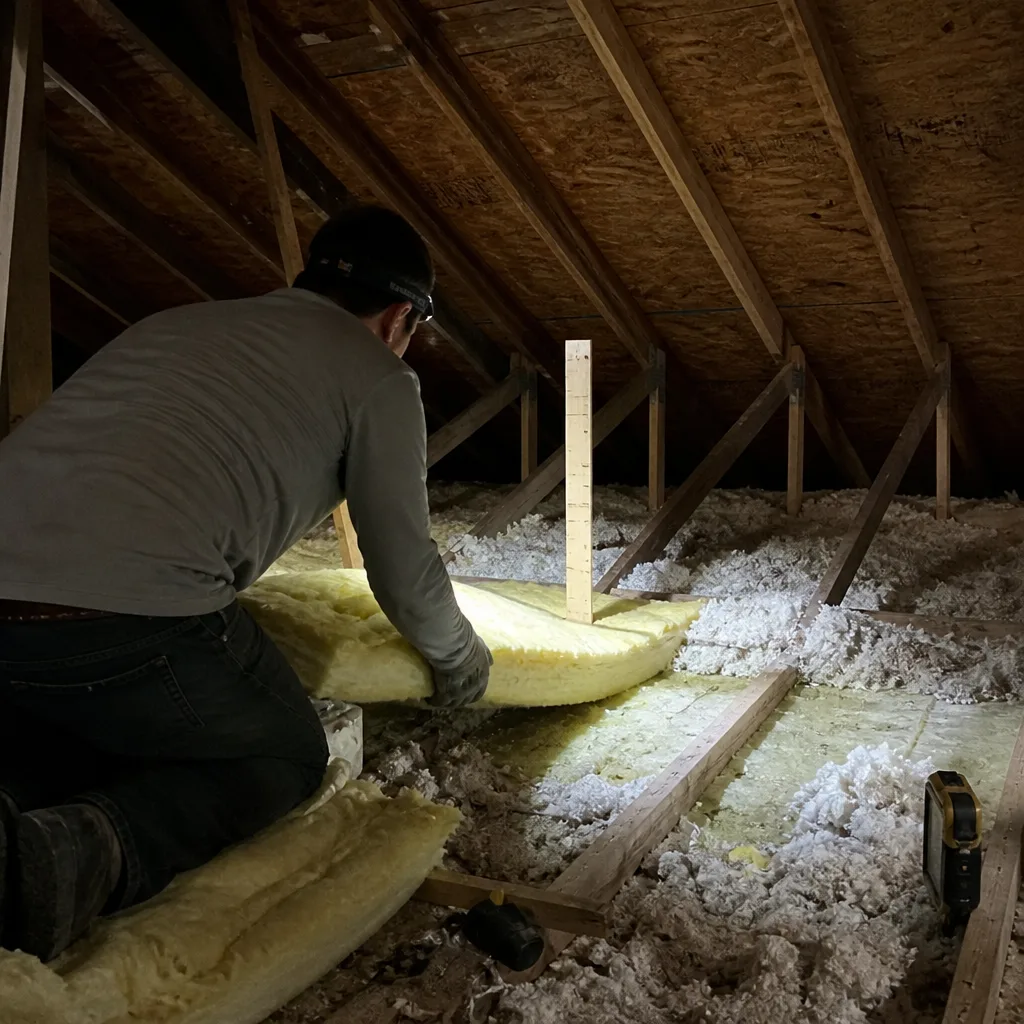
Canyon Lake isn’t Austin’s inner loop, but it’s not cheap either. Labor costs have risen with demand from Hill Country growth, and material prices in 2026 reflect supply chain conditions that settled higher than pre-2022 baselines. Here’s what specifically moves your number up or down.
- Open vs. closed walls. If your walls are already drywalled – the case in almost every retrofit job in Canyon Lake – the insulation has to be dense-packed through small holes drilled in each stud bay, then patched. That drilling and patching adds labor. Open walls (new construction, gut renovation) are faster and less expensive to insulate but require you to coordinate with your GC’s framing schedule.
- Wall depth and framing type. Standard 2×4 walls have about 3.5 inches of cavity – enough for R-13 to R-15. The 2×6 walls in post-2005 Canyon Lake construction hold R-19 to R-21 with fiberglass batt or higher with spray foam. More depth means more material, but it also means a better thermal result for a home that runs AC from April through October.
- Existing insulation condition. Quite a few Canyon Lake homes built in the 1980s and 1990s have original fiberglass batts that have settled, compressed, or been disturbed by pest activity. If existing material needs to come out first, expect to add $0.50 to $1.25 per square foot for removal – and a blower-door test before you commit tells you whether it’s actually worth doing.
- Canyon Lake’s climate position. The area sits in IECC Climate Zone 2 – a hot and humid designation that means summer cooling loads drive most of the thermal penalty from under-insulated walls. Humidity off the lake also matters: dense-pack cellulose and open-cell spray foam behave differently in high-relative-humidity wall assemblies, and the wrong choice can trap moisture. That’s a decision a blower-door technician thinks about differently than a salesperson does.
- Access and job complexity. Homes on Canyon Lake’s hillside lots – particularly around Startzville and the Lake Estates sections – often have irregular exterior wall layouts, split levels, or additions that create non-standard stud bays. Each non-standard bay takes longer to fill correctly. A visual walk of the home before a price is written is non-negotiable; anything quoted remotely without seeing the walls is a guess.
- Material choice. The price gap between cellulose and closed-cell spray foam is real – sometimes two to three times the per-square-foot cost. Closed-cell makes sense when you need maximum R-value per inch (as in a shallow 2×4 wall where you want R-20+) or when the wall assembly faces a high vapor drive from exterior humidity. Cellulose makes sense for most existing Canyon Lake homes on a value-per-R-value basis. We don’t push one over the other; we show you the numbers for both on the written scope.
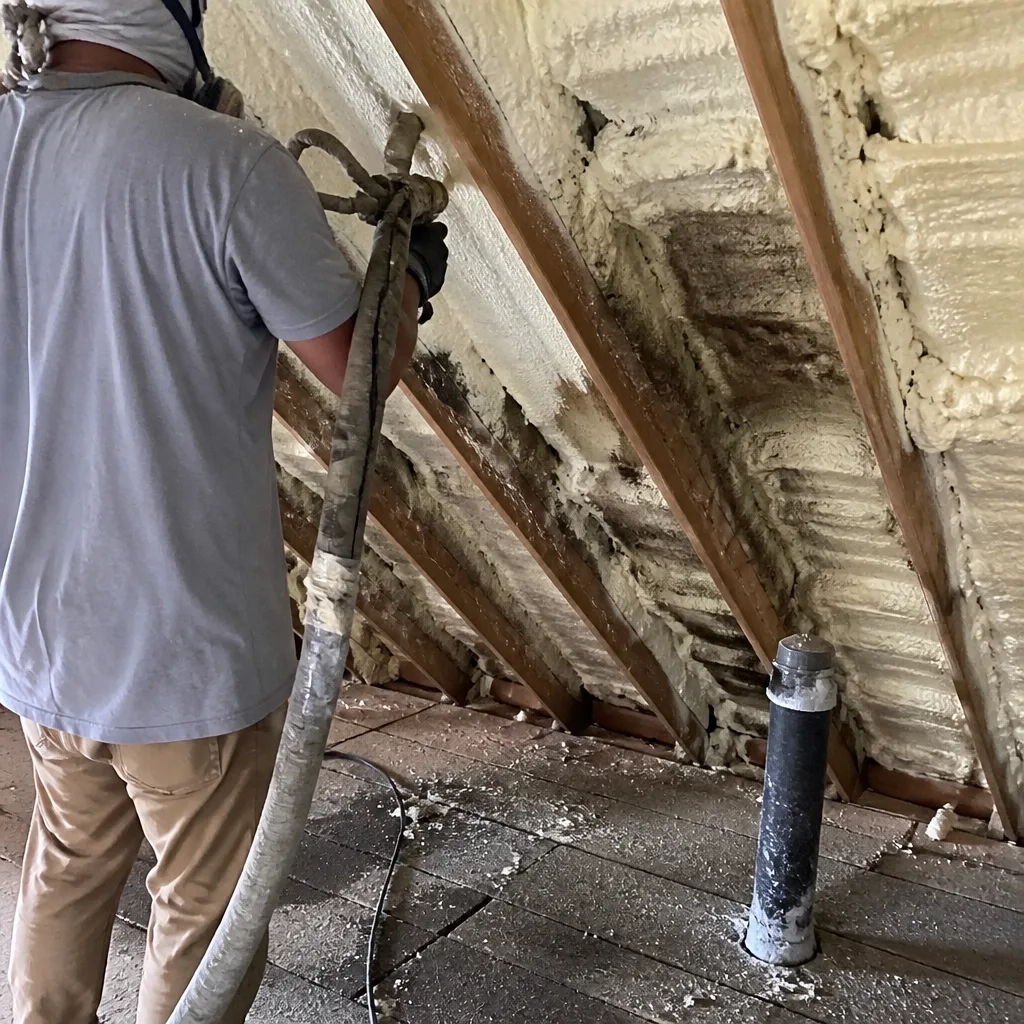 Before
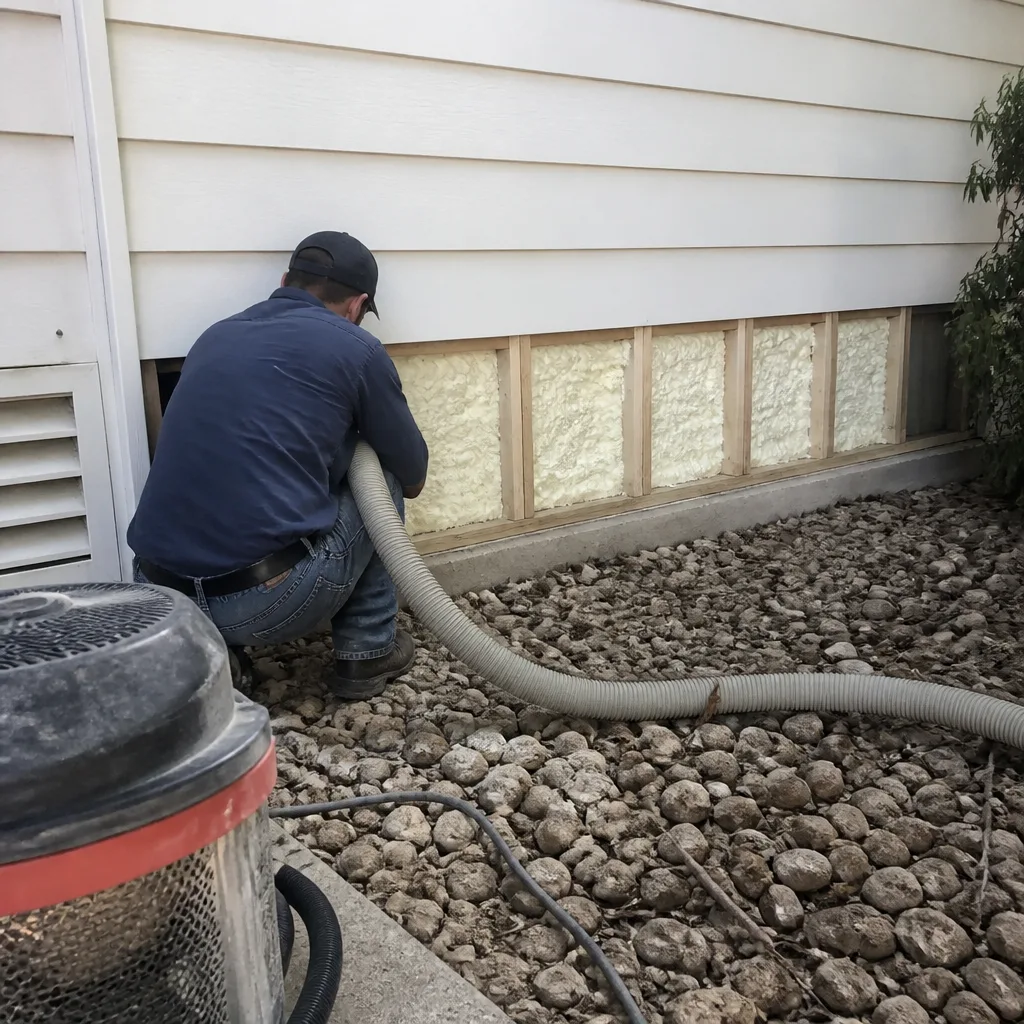 After
AfterHow to Save on Wall Insulation in Canyon Lake
Saving on wall insulation doesn’t mean finding the lowest per-square-foot bid. It means getting the work that actually changes the performance of your home at a price that’s fully written before anyone starts. Here’s how Canyon Lake homeowners get to that outcome.
Start with a blower-door test before committing to scope
A blower-door test – a pressurization reading that shows, in one number, how much air your building envelope is losing – tells you where the real thermal penalty is. If your attic bypasses are the dominant leak, wall insulation may be a lower-priority spend. If the walls are the gap, you’ll know it from the data, not from a salesperson’s recommendation. We publish before-and-after readings on every applicable job under Envelope Insulation Co.’s standard practice, so the investment is verifiable rather than theoretical.
Dense-pack for closed walls, spray foam for open ones
If your Canyon Lake home already has drywall up, dense-pack blown-in cellulose or fiberglass is almost always the more cost-effective path. Spray foam requires wall access to be worth the premium. Paying closed-cell spray foam prices for a closed-wall retrofit is almost never justified by the thermal return.
Combine projects when walls are already open
If you’re renovating a bathroom, replacing windows, or repairing drywall, that’s the lowest-cost window to address wall insulation – the labor for access is already spent. Canyon Lake homeowners doing window replacements often miss this. Adding dense-pack to newly exposed wall sections during a window job adds relatively little to the total project cost and eliminates the need to revisit later.
Bring us a written competing estimate
Under the Haven Standard, we’ll sit down with you and read any written estimate you’ve received from another contractor. Not to undercut it – to make sure you understand what it includes and what it doesn’t. Air sealing scope, material spec, warranty language: those are the items that separate a $2,100 quote from a $3,100 quote for what looks like the same job. Call us at (737) 227-6219 to schedule a free second opinion on any written estimate.
Understand utility rebates for Zone 2 homes
CPS Energy and some Comal County co-ops have offered rebate programs for wall insulation upgrades in qualifying homes – amounts and eligibility change year to year, so confirm with your provider before project start. The rebate documentation typically requires a pre-project assessment and post-project verification. We can provide the written documentation you’d need; confirm program availability with your utility directly.
Don’t skip air sealing to reduce the quote
This one sounds counterintuitive as a way to save money. But a wall cavity filled with R-15 cellulose that’s still leaking air at the top plate delivers maybe R-8 in real-world thermal performance. You paid for R-15 and got R-8. Skipping air sealing to lower the upfront cost means you’ve bought a result that won’t show up on your utility bills. That’s the most expensive way to do a wall insulation project in Canyon Lake.
Dense-Pack vs. Spray Foam for Canyon Lake’s Wall Assemblies
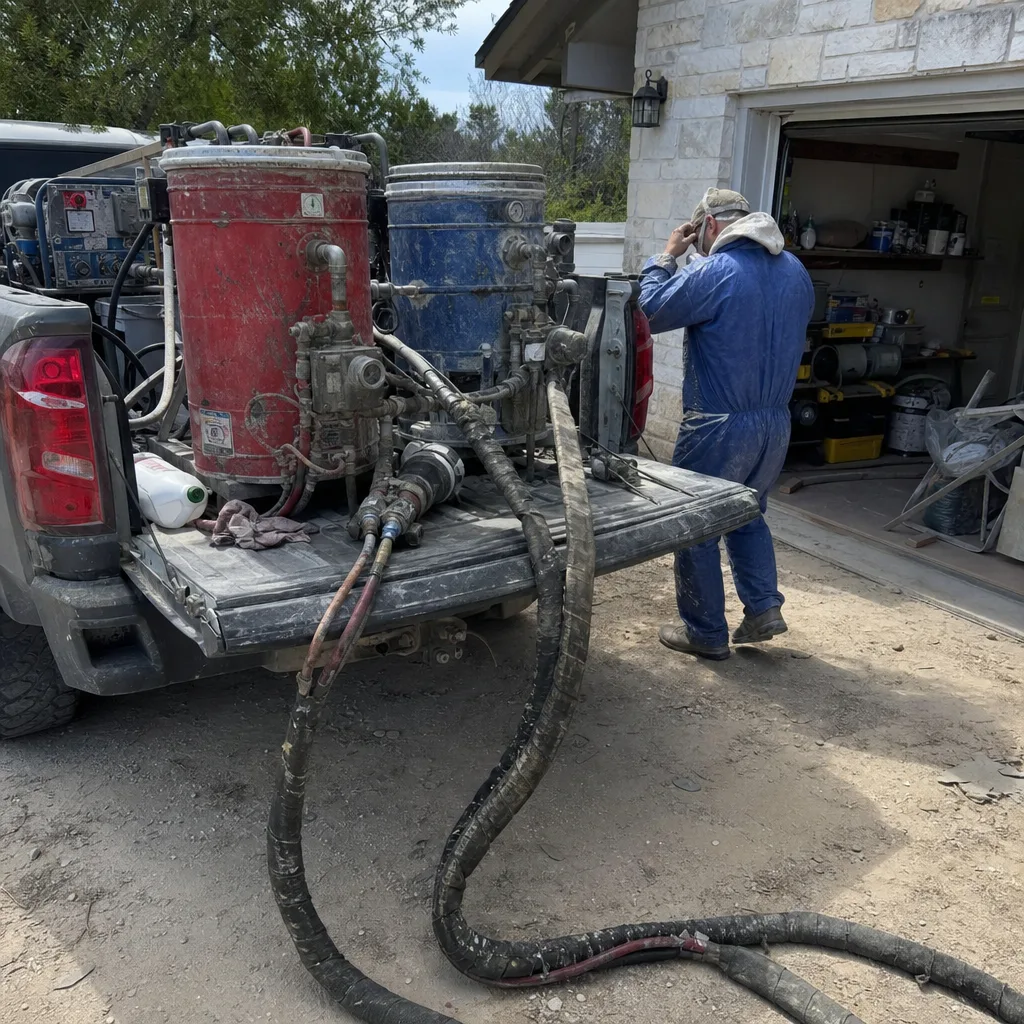
This is the decision most Canyon Lake homeowners get to last, but it should probably come first. The right answer depends on three things: whether your walls are open or closed, how much moisture your exterior walls see, and what R-value you’re trying to hit.
Dense-pack blown-in (cellulose or fiberglass)
Dense-pack is the standard for retrofit wall insulation in existing Canyon Lake homes. Small holes are drilled at each stud bay, material is packed in at a density high enough to prevent settling (cellulose typically at 3.5 lb/cubic foot), and the holes are patched and finished. Done correctly, it fills the cavity without voids. Done incorrectly – at too low a density or without checking for blocking – it settles and leaves cold spots. We photograph every step of a dense-pack job and include those images in the documented record you receive when we leave.
On the blower-door side: dense-pack alone doesn’t air-seal the wall plane. You can have a perfectly filled cavity and still have significant air movement through top plates, electrical boxes, and penetrations. Those are sealed separately, before the insulation goes in. That sequencing – seal first, then insulate – is what separates a performed result from a performed sale.
Spray foam (open-cell or closed-cell)
Spray foam makes the most sense in new construction or gut renovations where the stud bays are fully exposed. Open-cell foam (roughly R-3.7 per inch) air-seals as it’s applied, which is a real advantage in a single-step installation. Closed-cell (R-6.0 to R-7.0 per inch) adds a vapor retarder function that’s relevant in Canyon Lake’s humid conditions, particularly on north-facing walls or below-grade sections that see consistent moisture drive.
Spray foam involves isocyanates – the reactive chemicals that make the foam expand – and the application requires trained technicians with proper respiratory protection. This is not a DIY material for good reason. For an existing Canyon Lake home with walls already drywalled, the spray foam conversation is largely academic unless you’re opening the walls for another reason.
What the Wall Insulation Process Looks Like With Us
Under Haven Standard Clause 1: a written price before any work starts, always. No verbal estimates, no ballpark-and-adjust. Here’s the sequence for a typical Canyon Lake wall insulation job.
- Written price and scope, before anything starts. Wes Okafor or a lead technician walks the home, assesses the wall assembly, and produces a flat written price with a written scope and written warranty. You review it. You sign if it works. No work starts before that.
- Pre-job blower-door reading (applicable jobs). For full-envelope projects, we run the blower-door before a single hole is drilled. That baseline number is what we’ll compare against when the job is done.
- Air sealing of top plates, penetrations, and electrical boxes. This happens first. Every time. The insulation goes in after the air leaks are addressed – not simultaneously, not afterward.
- Dense-pack or batt installation, documented by photo. Every stud bay, every patched hole, every material batch. The photos go into the documented record you receive.
- Post-job blower-door reading. On applicable jobs, we run the test again and give you both numbers – the before and the after – in writing. You see what you paid for, in a single figure.
- Written warranty and 365-Day Done Right Promise. If something isn’t right within a year of completion, we make it right. That’s in writing before we leave.
Learn more about the full scope of what we do on our Wall Insulation in Canyon Lake service page.
FAQs – Wall Insulation Cost in Canyon Lake, TX
How much does wall insulation cost in Canyon Lake per square foot?
Our Wall Insulation services in Canyon Lake run between $1.50 and $4.25 per square foot of wall area, installed, depending on the method. Dense-pack blown-in cellulose for a closed existing wall comes in at $1.75 to $2.75 per square foot. Closed-cell spray foam for an open wall runs $3.25 to $4.25 or more. Those ranges are for installed work including labor and material in the current Canyon Lake market. Get a flat written number for your specific home at (737) 227-6219 – estimates are free and written before any work is scheduled.
Is it worth insulating the walls of an existing Canyon Lake home?
For most Canyon Lake homes built before 2000, yes – and the blower-door data usually confirms it. Homes in the area built in the 1980s and early 1990s commonly show walls with settled or missing fiberglass batts and significant air leakage at top plates. In Canyon Lake’s Climate Zone 2 designation, where AC runs from roughly April through October, an under-insulated wall assembly adds measurably to cooling load. A blower-door baseline before the project shows you the actual magnitude of the problem; the post-job reading shows whether the work moved the number.
How long does a wall insulation job take in Canyon Lake?
A typical single-story Canyon Lake home with 900 to 1,200 square feet of exterior wall area takes one full day for a dense-pack retrofit – including air sealing, drilling, packing, patching, and post-job documentation. Two-story homes or homes with complex floor plans run one to two days. We provide a named technician and a text when they’re on the way, under the Haven Standard. No arrival windows measured in half-day blocks.
Does wall insulation require a permit in Canyon Lake?
Canyon Lake falls under Comal County jurisdiction rather than a city permit office. For most insulation-only retrofit work – dense-pack through existing drywall with no structural changes – a permit is not typically required under current Comal County code. If the project involves opening walls as part of a larger renovation, the GC’s permit may cover insulation scope. Confirm with Comal County Development Services for your specific project before work starts; code requirements change and vary by project type.
Can you insulate just one wall instead of all exterior walls?
Yes, and it sometimes makes sense. Partial-wall projects are common in Canyon Lake when a specific wall – usually a west-facing wall that takes afternoon sun or a wall adjacent to a converted garage – is the clear performance problem. A partial project runs roughly the same per-square-foot rate as a full project, since the labor cost of setup, air sealing, and documentation doesn’t scale down proportionally. We’ll tell you if the data supports a partial approach or if the full-wall job pencils out better on a per-R-value basis.
What’s the difference between insulating walls and insulating the attic?
Attic insulation and wall insulation address different parts of the thermal envelope. In most Canyon Lake homes, the attic is the higher-priority project because heat gain through the roof deck is typically larger than through walls – and attic access makes the installation simpler and less expensive per square foot. Wall insulation matters most in homes with little or no existing wall fill, significant west-facing exposure, or above-average air infiltration through the wall plane. A blower-door test before either project tells you which gap is costing you more. Call (737) 227-6219 for a free estimate and we’ll read the numbers with you before recommending a scope.
Why Canyon Lake Homeowners Work With Envelope Insulation Co.
Since 2016, we’ve sealed and insulated more than 9,000 homes – every one with a written price before work started and a documented record when the crew left. That’s not a marketing claim; it’s the operating requirement under The Haven Standard that every Envelope job runs on.
For Canyon Lake specifically, a few things matter. The lake humidity changes how wall assemblies perform. The hillside lot layouts in areas like Startzville, Lake Estates, and along FM 2673 create access challenges that affect labor pricing. And the Climate Zone 2 designation means a wall that tests fine in a mild spring genuinely underperforms from June through September when it matters most.
Wes Okafor leads every project scoping call with the same question: what does the blower-door say before we decide what to install? That’s the sequence that produces a result you can verify rather than a result you have to take on faith.
Under Haven Standard Clause 1, you get a flat written price before anyone picks up a tool. Under the 365-Day Done Right Promise, if it’s not right, we make it right – and that’s in writing too. Bring us any written estimate you’ve received and we’ll read it with you, free, no obligation.
Call (737) 227-6219 to schedule a free wall insulation estimate for your Canyon Lake home. A live person answers – no voicemail, no callback window.
Written by Wes Okafor, Owner at Envelope Insulation Co. (operating as Topside Attic Insulation Canyon Lake), serving Canyon Lake, TX since 2016. Pricing reflects the Canyon Lake market as of 2026. Topside Attic Insulation Canyon Lake offers free estimates – call (737) 227-6219.
What Our Customers Say
"The winter gas bill dropped by about a third. They had estimated a quarter, so they under-promised."
- Genevieve R."They photographed rodent damage in the old insulation that we had no idea about, and priced the exclusion work separately so we could decide."
- Harriet N."Two other companies quoted to blow more insulation on top of what was there. These were the only ones who said the existing material had to come out first, and explained why."
- Clifford E.