
Crawl Space Vapor Barrier in Canyon Lake, TX
A crawl space vapor barrier is a heavy-duty polyethylene sheet – typically 12 to 20 mil thick – installed across the ground and up the foundation walls of your crawl space to block ground moisture before it reaches your floor system, insulation, and living space above. In Canyon Lake, where the Guadalupe River corridor keeps humidity elevated through most of the spring and summer, an unprotected dirt crawl space floor acts like an open evaporation pan. Most Canyon Lake homes with crawl spaces that lack a proper barrier show moisture readings of 70 percent relative humidity or higher inside that space by mid-May, and wood rot or mold follows within a season or two.
At Topside Attic Insulation Canyon Lake, a vapor barrier installation starts with a documented moisture assessment – not a product pitch. We measure what’s happening under your home before we recommend anything, and every job comes with a written price before any work begins. That’s Haven Standard Clause 1, and it applies here the same as it does on every job we complete. If you’d like to see the full picture of what crawl space moisture control involves – sealing, insulation, and drainage coordination – the Crawl Space Encapsulation & Vapor Barrier in Canyon Lake page walks through the complete service. To schedule a free assessment, call us at (737) 227-6219.
When You Need a Crawl Space Vapor Barrier
Not every crawl space problem announces itself loudly. Some of the clearest indicators we see in Canyon Lake homes are quiet ones – a floor that feels soft underfoot near the exterior walls, or a faint musty odor that disappears when you open windows but comes back within a day. Here’s what typically points to a missing or failed vapor barrier:
- Visible moisture on the ground or standing water after rain. Canyon Lake sits in the Hill Country, where limestone drainage moves water fast and unpredictably. After heavy rainfall, water can wick up through a bare dirt floor for days even when no obvious flooding occurred.
- High humidity readings inside the crawl space. We use a calibrated hygrometer on every assessment. If the reading inside the crawl space is more than 15 points higher than the outdoor reading, ground moisture is actively evaporating into the space – and eventually into your subfloor and floor joists.
- Soft, springy, or squeaky floors above the crawl space. Wood floor joists that have cycled through repeated wetting and drying lose structural rigidity before visible rot appears. In homes near the Canyon Lake marina area, we see this pattern regularly in houses built on pier-and-beam foundations with no ground cover at all.
- Insulation that has fallen from the joist bays or shows dark staining. Batt insulation – whether Johns Manville or Owens Corning – absorbs moisture and loses its R-value when the crawl space below it is humid. A dropped batt is often the first visible sign that moisture has been accumulating for longer than the homeowner realized.
- Higher-than-expected cooling bills in spring and early summer. Evaporating ground moisture drops the temperature of your subfloor and increases the latent load on your HVAC system. Homes on Cranes Mill Road and around the Fm 2673 corridor frequently show this pattern before any visible damage appears.
- Pest activity or evidence of wood-destroying insects. Subterranean termites require soil contact and moisture to thrive. A bare crawl space floor creates exactly those conditions. A properly installed vapor barrier disrupts that relationship by eliminating the moist soil surface they need.
Our Crawl Space Vapor Barrier Process
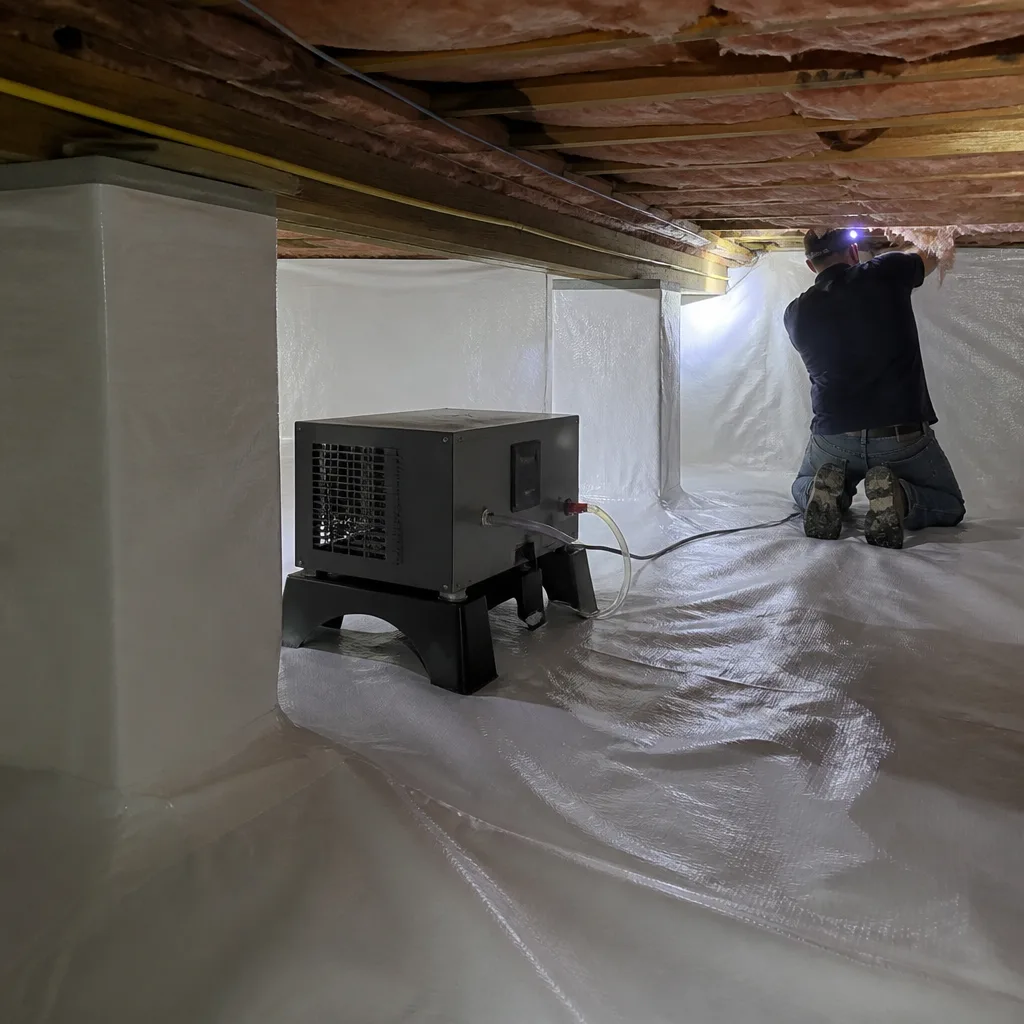
The steps below are what actually happens on every vapor barrier job we complete in Canyon Lake. There are no shortcuts between steps, and the sequence matters – each one is a prerequisite for the next.
-
Pre-installation moisture and inspection assessment.
Before any material touches the ground, we photograph the entire crawl space and record ambient moisture readings at multiple points across the floor. We note wood moisture content at the joists, check for any existing standing water or pooling, and document the condition of any existing insulation or vapor control material. This record becomes part of your Documented Photo Record – you receive it when the job closes, not only if you ask for it. -
Clearing and prepping the ground surface.
Debris, old degraded plastic sheeting, and any loose material that would prevent the new barrier from lying flat are removed. If there are sharp rocks or concrete protrusions common to Canyon Lake’s limestone substrate, we address those before installation so they don’t puncture the liner over time. Vapor barriers fail at their weakest point, and that’s almost always a puncture that was preventable. -
Installing the vapor barrier material.
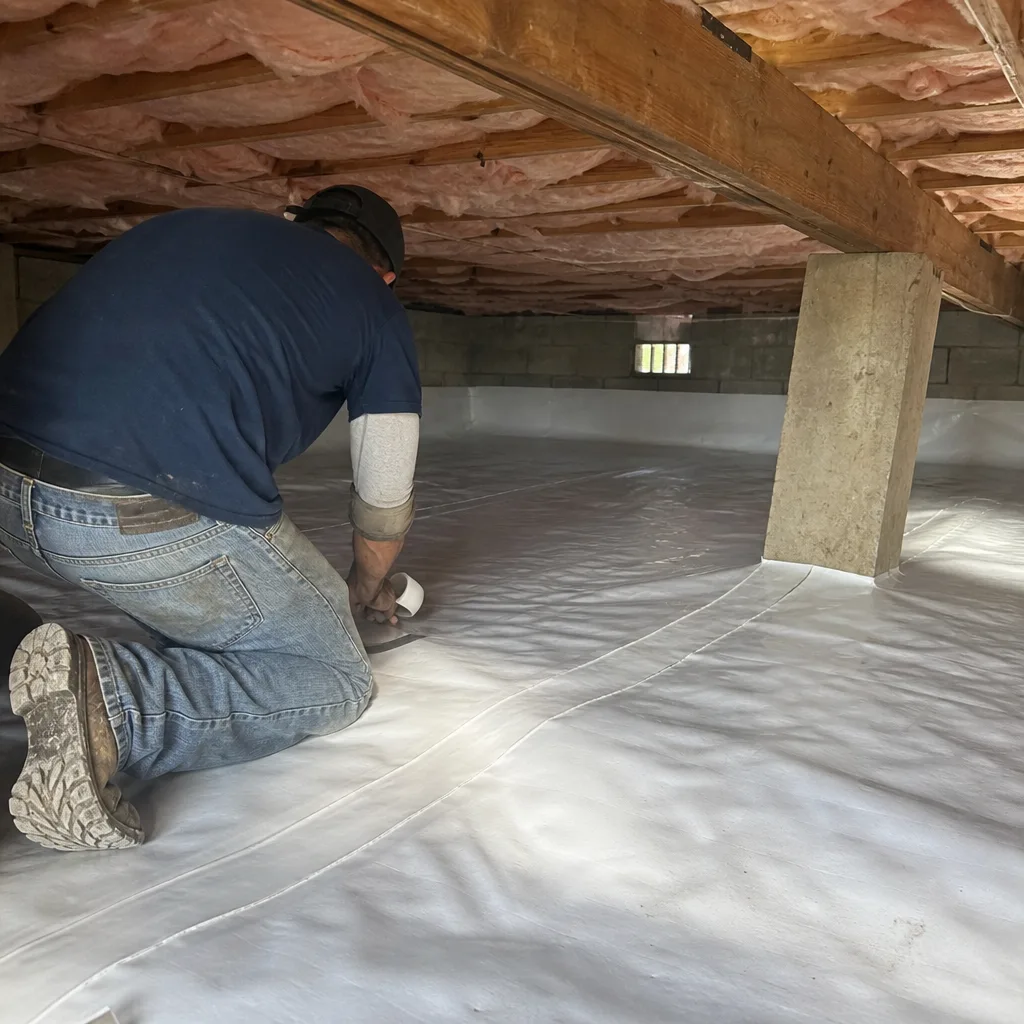
We install a minimum 12 mil polyethylene liner – heavier mil (up to 20 mil) on jobs where we expect higher traffic in the crawl space or where the ground surface is unusually rough. The liner runs across the entire floor and extends up the foundation walls to at least six inches above the soil grade line. Seams are overlapped a minimum of twelve inches and sealed with moisture-resistant tape rated for long-term adhesion – not the standard poly tape sold at hardware stores, which fails within a few years under crawl space temperature swings. -
Securing the barrier to the foundation walls.
The liner is fastened to the masonry wall with a mechanical fastener system and then sealed with a breathable but moisture-blocking mastic at the perimeter. This step is frequently skipped by contractors who treat vapor barriers as a floor-only product. It isn’t. Ground moisture migrates along the wall, and a barrier that terminates at the floor-wall junction leaves that path open. -
Addressing penetrations – piers, columns, and pipes.
Every pipe penetration, support column, and pier that passes through the liner gets individually wrapped and taped. This is the detail work that separates a barrier that performs for fifteen years from one that allows moisture ingress at every structural element. On Canyon Lake homes with multiple piers – common in older construction on the steeper lots – this step adds time to the job, and that time is reflected honestly in your written estimate before we start. -
Post-installation documentation and walk-through.
Once the liner is down and secured, we photograph the completed installation at every wall junction, each pier wrap, and across the full floor. Moisture readings are taken again. If the crawl space had an existing insulation problem that we’re coordinating with separately, this is where we confirm the subfloor is ready for that next step. You leave with a written record of what was installed, where seams fall, and what the pre- and post-moisture readings show.
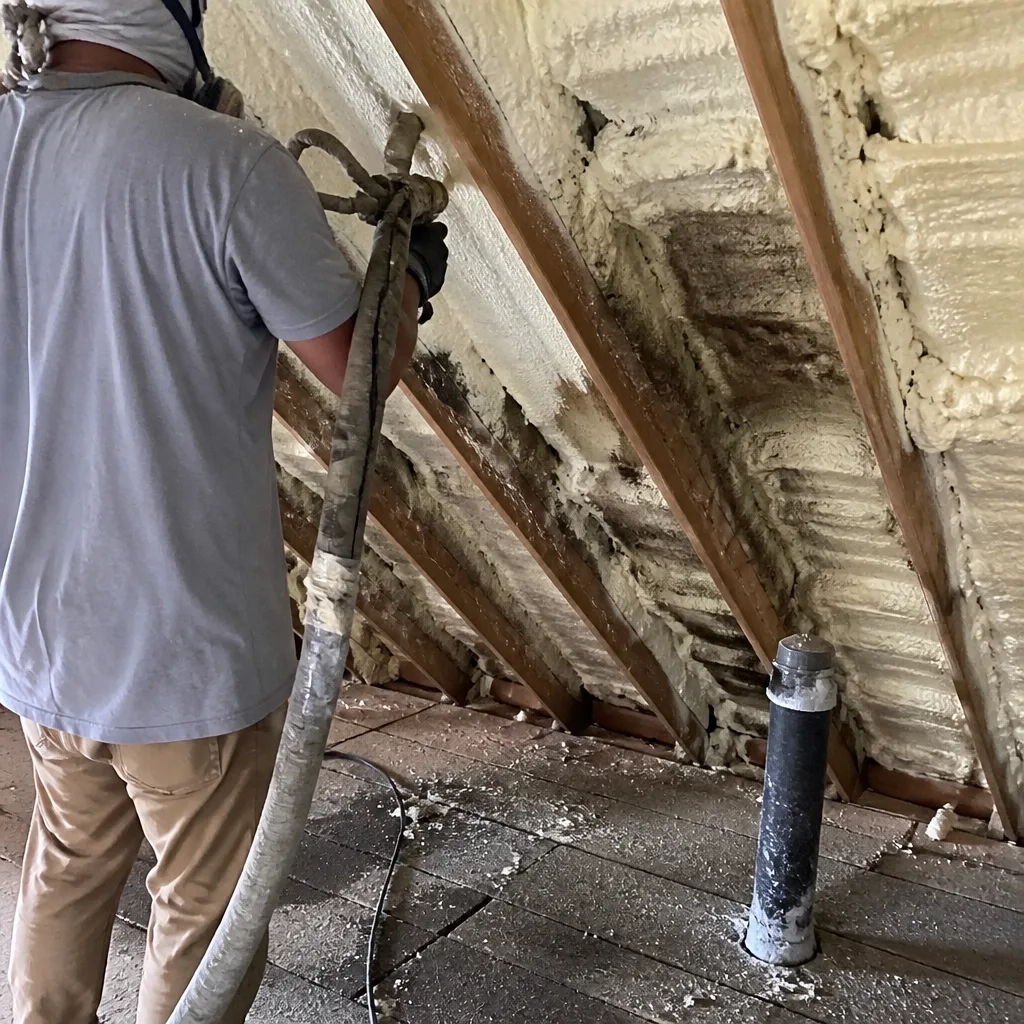 Before
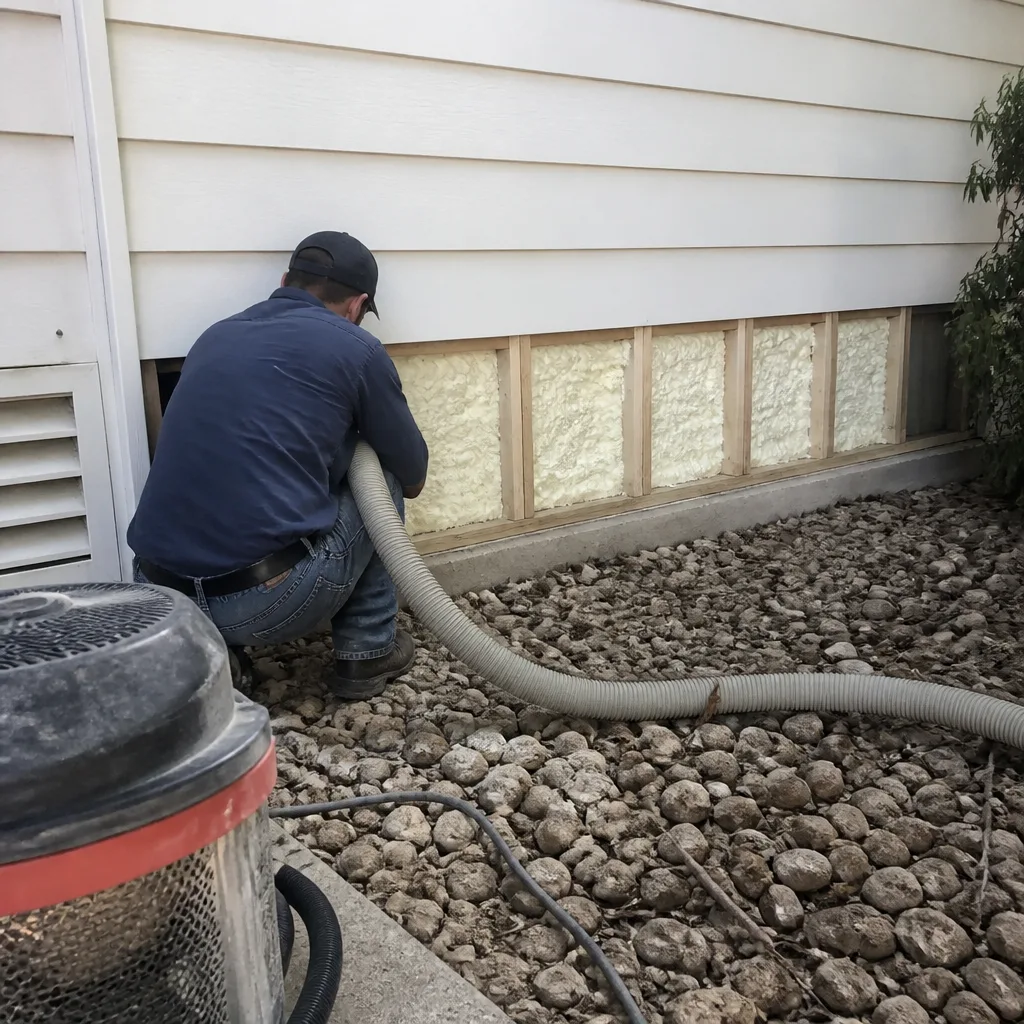 After
AfterCrawl Space Vapor Barrier Pricing in Canyon Lake
Crawl space vapor barrier installation in Canyon Lake typically runs between $1,200 and $3,800 for a single-family home, depending on the factors below. That range covers material and labor as a complete installed system – not just the liner material itself.
| Factor | Lower End | Higher End |
|---|---|---|
| Crawl space square footage | Under 800 sq ft | 1,500+ sq ft |
| Liner thickness | 12 mil (standard) | 20 mil (heavy use or rough substrate) |
| Access difficulty | Standard hatch, full standing clearance | Low clearance (under 18″), limited access points |
| Number of piers and penetrations | 4 or fewer | 10+ (common in older Canyon Lake pier-and-beam homes) |
| Old material removal | No prior barrier exists | Degraded liner, old fiberglass batts, or debris present |
| Wall coverage included | Floor only (not recommended) | Full perimeter wall coverage to grade line |
The most common job we complete in Canyon Lake falls in the $1,600 to $2,400 range – a home with 900 to 1,200 square feet of crawl space, a handful of piers, and no prior barrier. Homes on sloped lots near the lake, where crawl space access is constrained and clearance is lower, sit at the higher end of the range because the work takes more time and more material to do correctly.
Under Haven Standard Clause 1, you receive a flat written price and a written scope before anyone starts. No material gets unloaded until you’ve read the price and agreed in writing. If you have a competing written estimate, bring it – we offer a free second opinion on any written quote and will read it with you line by line.
To get a written estimate for your Canyon Lake home with no obligation, call (737) 227-6219. We’ll schedule a moisture assessment, document what we find, and give you a price you can hold us to.
FAQs – Crawl Space Vapor Barrier
How thick should a crawl space vapor barrier be in Canyon Lake?
A 12 mil polyethylene liner is the minimum we install in Canyon Lake crawl spaces, and we use 20 mil on jobs where the ground is unusually rough or where the space will see regular foot traffic for mechanical access. Thinner materials – the 6 mil sheeting sold at hardware stores – puncture easily on limestone substrate and degrade faster under the temperature cycling that Canyon Lake crawl spaces see between January and August. The difference in material cost between 6 mil and 12 mil is modest; the difference in service life is not. Call (737) 227-6219 for a written estimate that specifies which liner thickness applies to your home and why.
Can I install a crawl space vapor barrier myself?
The liner itself isn’t dangerous to work with, but the quality of the installation – particularly the wall termination, pier wraps, and seam sealing – determines whether the barrier works for ten years or fails in two. Most of the DIY installs we assess in Canyon Lake share two problems: seams that weren’t lapped and taped adequately, and wall coverage that terminated at the floor-wall junction rather than running up the masonry. Those gaps allow moisture to track in exactly where the barrier was supposed to stop it. If you’re considering a DIY approach, at minimum have a contractor document your moisture readings before and after so you know whether the installation is actually performing. We’ll do that assessment and give you the numbers honestly.
What is the difference between a vapor barrier and full crawl space encapsulation?
A vapor barrier addresses ground moisture by covering the floor and walls of the crawl space with a polyethylene liner. Full Crawl Space Encapsulation & Vapor Barrier in Canyon Lake goes further: it seals all vents, installs a conditioned or dehumidified air supply, and often includes a perimeter drainage channel and sump system if groundwater intrusion is present. A vapor barrier is the foundation of encapsulation – you can’t do encapsulation well without a correctly installed liner – but encapsulation does more to control the humidity of the air inside the space, not just the evaporation from the ground. For most Canyon Lake homes where the primary issue is ground moisture rather than chronic water intrusion, a correctly installed vapor barrier is the appropriate starting point. We’ll tell you clearly which one your home needs after the assessment, and we won’t recommend encapsulation if a vapor barrier is what the reading supports.
How long does a crawl space vapor barrier last?
A correctly installed 12 mil polyethylene liner in a Canyon Lake crawl space should perform for 15 to 25 years without replacement, assuming seams and penetrations were properly sealed at installation and no significant physical damage occurs over that period. Thinner materials or improperly sealed seams can fail in five years or fewer under the humidity and temperature swings common in this part of the Hill Country. Every liner we install is documented with photographs of every seam and junction, so if you ever have a warranty question or want to confirm the condition of a specific area, there’s a baseline record to compare against. Our 365-Day Done Right Promise covers the installation for the first year in writing – if something isn’t right, we make it right.
Why Canyon Lake Homeowners Choose Topside Attic Insulation
Canyon Lake’s crawl space environment is specific. The combination of limestone soil, seasonal flooding risk near the Guadalupe arm of the reservoir, and humidity levels that spike quickly after spring storms creates conditions that demand more precision than a standard vapor barrier installation. We’ve documented this in homes across the Canyon Lake area, from properties on Skyline Drive with steep-grade pier-and-beam foundations to newer slab-and-partial-crawl construction near the Canyon Lake Gorge area where builders left sections of the crawl space without crawl space insulation or vapor barrier protection.
Since 2016, Topside Attic Insulation Canyon Lake – operating under The Haven Standard – has completed crawl space moisture assessments and vapor barrier installations with the same documented process on every job: written price first, Documented Photo Record last, and nothing in between that wasn’t agreed to in writing. Wes Okafor leads every project review, and the 365-Day Done Right Promise means the written warranty you receive at job close isn’t a formality.
We work with materials from manufacturers including Owens Corning and Johns Manville where they apply to the broader crawl space system – we don’t have a proprietary liner to sell you. What we install is what the assessment says your crawl space needs, at a price written before anyone puts on kneepads.
Key Takeaways
- Canyon Lake’s limestone soil and river-corridor humidity make crawl space moisture control a year-round issue, not a seasonal one.
- A proper vapor barrier runs across the full floor and up the foundation walls – floor-only installations leave a documented moisture pathway open.
- Most Canyon Lake homes with crawl spaces in the 900 to 1,200 square foot range fall between $1,600 and $2,400 for a complete vapor barrier installation.
- Every job starts with a written price and ends with a Documented Photo Record. The 365-Day Done Right Promise is in writing before anyone starts.
- If you have a competing estimate, bring it – a free second opinion is part of the service.
If you’re seeing moisture signs under your Canyon Lake home, or you’re buying a home and want a baseline moisture assessment before closing, call (737) 227-6219. We’ll schedule the assessment, document what we find, and give you a flat written price before any work begins. That’s the only way we do it.
You can also learn more about the full service that includes drainage, air sealing, and humidity control by visiting our home page for the complete building-envelope service overview.
Written by Wes Okafor, Owner at Topside Attic Insulation Canyon Lake, serving Canyon Lake since 2016.