
Last updated September 24, 2026
Attic Insulation Maintenance Checklist for Canyon Lake Homeowners
Blown cellulose loses roughly 20 percent of its installed depth to settling in the first five years. A Canyon Lake attic installed to R-38, about 11 inches, can drift to R-30 performance without a single visible sign of damage from the attic hatch. Most maintenance guides tell you to “check for damage” once a year, which is operationally useless if you don’t know what damage looks like in this specific climate. This checklist gives you observable, measurable triggers: depth measurements at five locations, the visual signatures of AC condensate intrusion, wildlife compression channels, and ventilation failures you can diagnose with a $12 infrared thermometer.
Quick Answer
Attic insulation maintenance in Canyon Lake means measuring blown material depth at five points annually, checking for condensate staining near AC lines, verifying soffit baffles aren’t blocked, and looking for wildlife compression channels. If your depth has fallen more than 20 percent from installation or you spot dark clumping near HVAC equipment, it’s time for professional evaluation. A DIY depth check is sufficient for routine monitoring; a blower-door retest is warranted when your home feels drafty or energy bills spike without explanation.
Table of Contents
- How to Measure Insulation Depth (The 5-Point Protocol)
- R-Value to Depth Conversion for Canyon Lake Attics
- Spotting AC Condensate Intrusion in High-Humidity Summers
- Wildlife Compression Channels and Why Re-Fluffing Fails
- Soffit-to-Ridge Ventilation Check with an Infrared Thermometer
- DIY Depth Check vs. Blower-Door Retest: When to Call
- A Canyon Lake Annual Maintenance Schedule
- Common Mistakes to Avoid
- When to Call a Professional
- Frequently Asked Questions
 Before
 After
AfterHow to Measure Insulation Depth (The 5-Point Protocol)
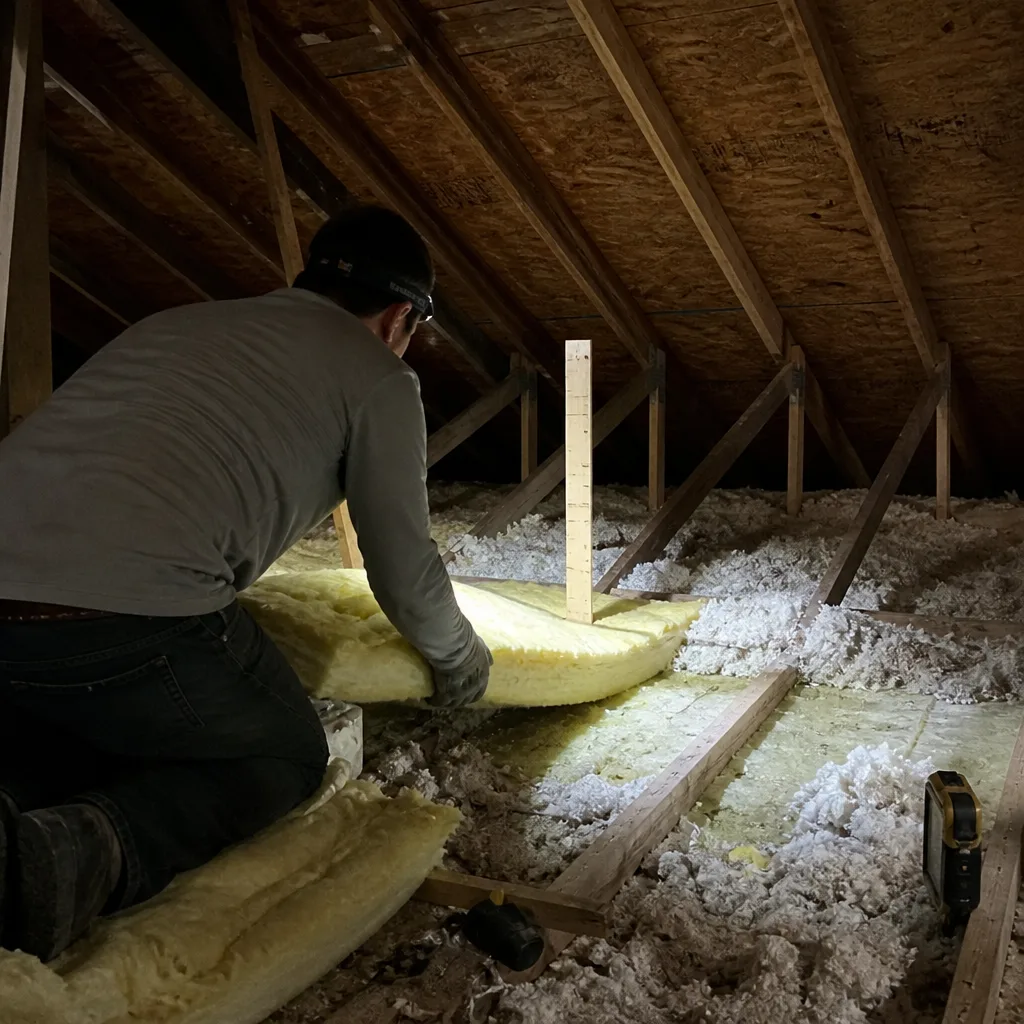
Depth measurement is the only maintenance task that tells you whether your insulation still performs at its labeled R-value. Settling is invisible from the hatch and progressive. In Canyon Lake, where summer attic temperatures regularly exceed 140°F, fiberglass binders degrade faster and cellulose compacts more readily than in cooler climates. You need five measurements, not one, because insulation depth varies significantly across a typical attic.
What you’ll need: A rigid ruler or measuring tape, a piece of cardboard to protect the material surface, a flashlight, and a notepad. Do this in early morning before the attic heats up.
- Center of attic, mid-span: Walk to the approximate center, away from any HVAC equipment or penetrations. Push the ruler vertically through the insulation until you hit the drywall or top plate. Record the depth to the nearest quarter inch.
- North side, 6 feet from eave: Canyon Lake’s northern exposures see less direct sun but more wind-driven rain intrusion. Measure here to catch any moisture-related settling.
- South side, 6 feet from eave: Maximum thermal cycling occurs here. Compare this reading to the north side; a gap of more than 2 inches suggests uneven installation or localized degradation.
- Near the attic hatch: Disturbance from access creates compaction. This measurement typically reads 10-15 percent lower than mid-span; if it’s more than 20 percent lower, the hatch perimeter needs air sealing.
- Directly above a top plate or interior wall: These are natural thin spots where blown material struggles to achieve full depth. If this reads more than 25 percent below your mid-span measurement, the original installation likely skipped critical air sealing at the plate line.
Record all five measurements with dates. We recommend taping a small index card inside the attic hatch cover with your baseline depths from installation. At Topside Attic Insulation Canyon Lake home visits, our crews document these reference points on the photo record we deliver before leaving.
Take photographs of each measurement location with your phone. If you ever call for a free second opinion on another contractor’s work, these photos let us compare current state to your documented baseline without a site visit.
R-Value to Depth Conversion for Canyon Lake Attics
R-value measures thermal resistance per inch of material. Canyon Lake sits in Climate Zone 2, where the 2021 IECC recommends R-30 to R-49 for attic insulation depending on construction type and whether the space is conditioned. Most homes built between 2015 and 2025 in Canyon Lake’s newer developments, like those off FM 306 and along Comal County’s ridge lines, were originally insulated to R-38. For full context on regional requirements and material options, read The Complete Guide to Insulation in Canyon Lake. Older homes near the reservoir may still sit at R-19 or R-22.
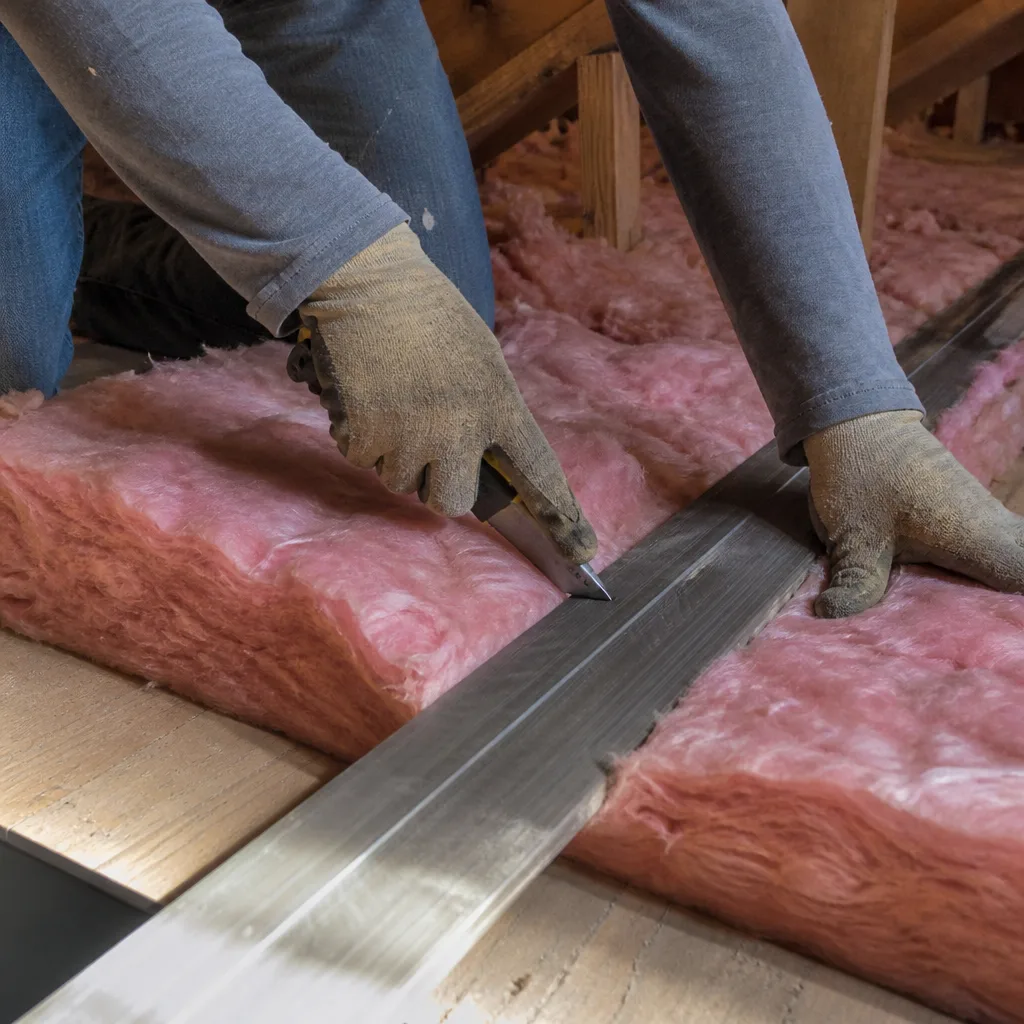
The critical point: R-value per inch differs between cellulose and fiberglass. Cellulose runs about R-3.2 to R-3.8 per inch when settled. Fiberglass batts run R-3.0 to R-3.3 per inch; loose-fill fiberglass runs R-2.5 to R-3.0 per inch depending on density and whether it’s CertainTeed InsulSafe SP, Owens Corning AttiCat, or another product. The table below uses conservative settled values for Canyon Lake’s hot-climate conditions.
| Target R-Value | Minimum Cellulose Depth (settled) | Minimum Fiberglass Depth (settled) |
|---|---|---|
| R-30 | 9.5 inches | 10.5 inches |
| R-38 | 11.5 inches | 13 inches |
| R-49 | 14.5 inches | 16.5 inches |
These are minimums, not targets. If your original installation spec called for R-38 cellulose at 11.5 inches settled, and you measure 9 inches at two or more of your five points, you’ve lost approximately 22 percent of your thermal performance. That translates directly to runtime hours on your AC compressor during Canyon Lake’s July and August cooling load peaks.
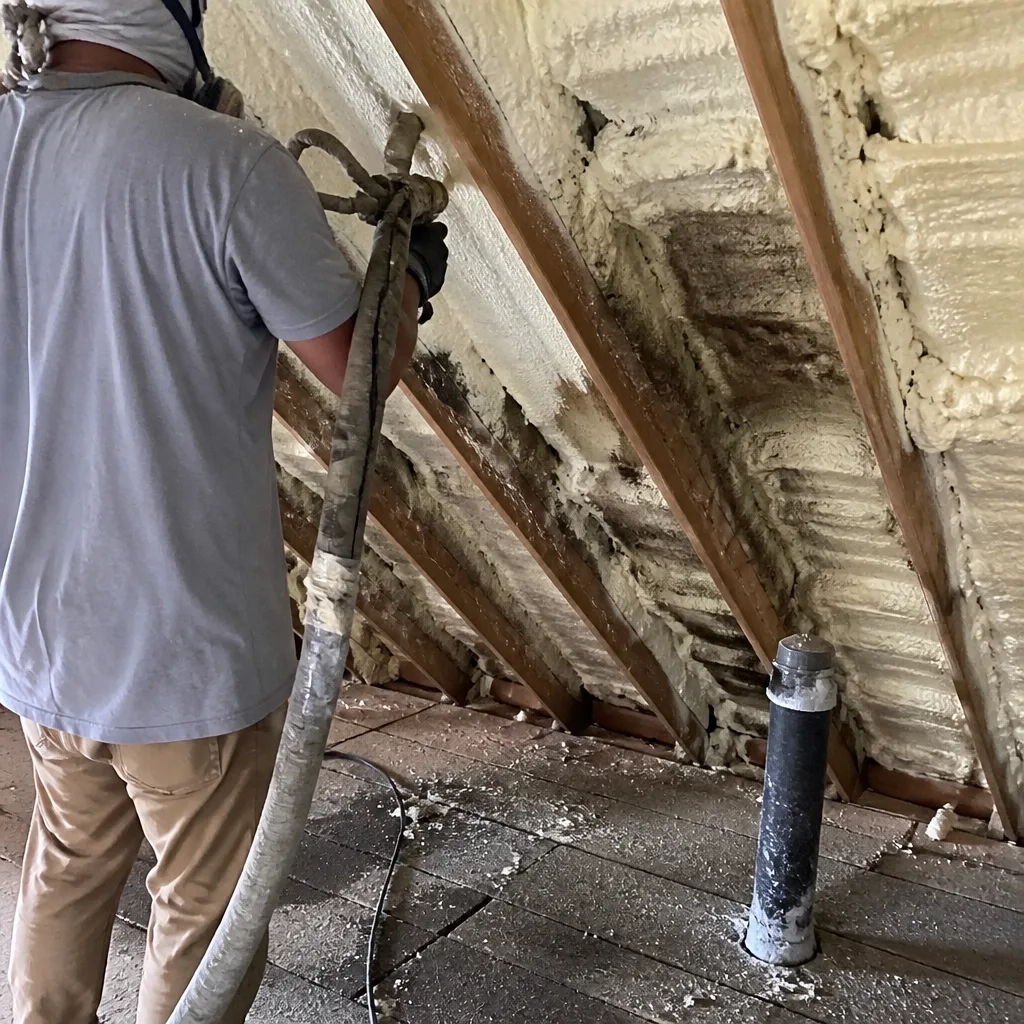
One more variable: spray foam. Spray foam insulation in Canyon Lake applications, whether open-cell Icynene or closed-cell Demilec, don’t settle in the same way. Maintenance for spray foam means checking for physical damage, delamination from substrates, or UV degradation if any foam is exposed. Depth measurement doesn’t apply; instead, look for yellowing, crumbling, or gaps where the foam has pulled away from framing members.
Spotting AC Condensate Intrusion in High-Humidity Summers
Canyon Lake’s summer humidity regularly pushes dew points above 70°F. Your AC system works harder and longer, and condensate production increases proportionally. When condensate lines clog, overflow, or simply sweat excessively in an unconditioned attic, the water finds your insulation.
The signs are specific and progress through predictable stages. Learn them and you catch problems before they require full insulation replacement.
Stage 1: Dark staining on insulation surface. Look directly beneath your air handler and along the condensate drain line path. Cellulose turns gray-brown; fiberglass turns yellow-brown. The stain pattern follows gravity, so it spreads downward and outward in a cone shape. If you see this, the condensate issue is active or was active recently.
Stage 2: Clumping and matting. Wet cellulose forms dense, cake-like masses that no longer loft. Wet fiberglass mats down into sheets. Either condition destroys the air pockets that provide insulation value. A clumped zone might read full depth on your ruler but perform at half its rated R-value because the material has lost its structure.
Stage 3: Compressed zones with visible channeling. Water follows the path of least resistance, creating runnels through the insulation. These channels become thermal bypasses, essentially uninsulated highways for heat transfer. In Canyon Lake’s August heat, a single 6-inch channel above a bedroom can raise ceiling surface temperature by 8-12°F.
Stage 4: Mold and mildew on rafters or sheathing. By this point, the insulation is secondary damage. You’re looking at potential structural decay and indoor air quality issues. Any musty smell from attic vents or return air registers warrants immediate professional inspection.
The fix isn’t replacing insulation alone. The condensate source must be resolved first: cleared drain lines, properly sloped pans, insulated lines where sweating occurs, and sometimes a condensate pump relocation. At Envelope Insulation Co., we won’t install new material over a wet substrate; under Haven Standard, the written scope specifies dry, sealed conditions before any insulation touches the attic floor.
One Canyon Lake-specific note: homes near the lake itself, in areas like Canyon Lake Hills or the Peninsula, experience higher ambient humidity than homes at elevation on the north side. Condensate issues develop faster there. If you’re in one of these neighborhoods, check your AC lines quarterly, not annually.
Wildlife Compression Channels and Why Re-Fluffing Fails
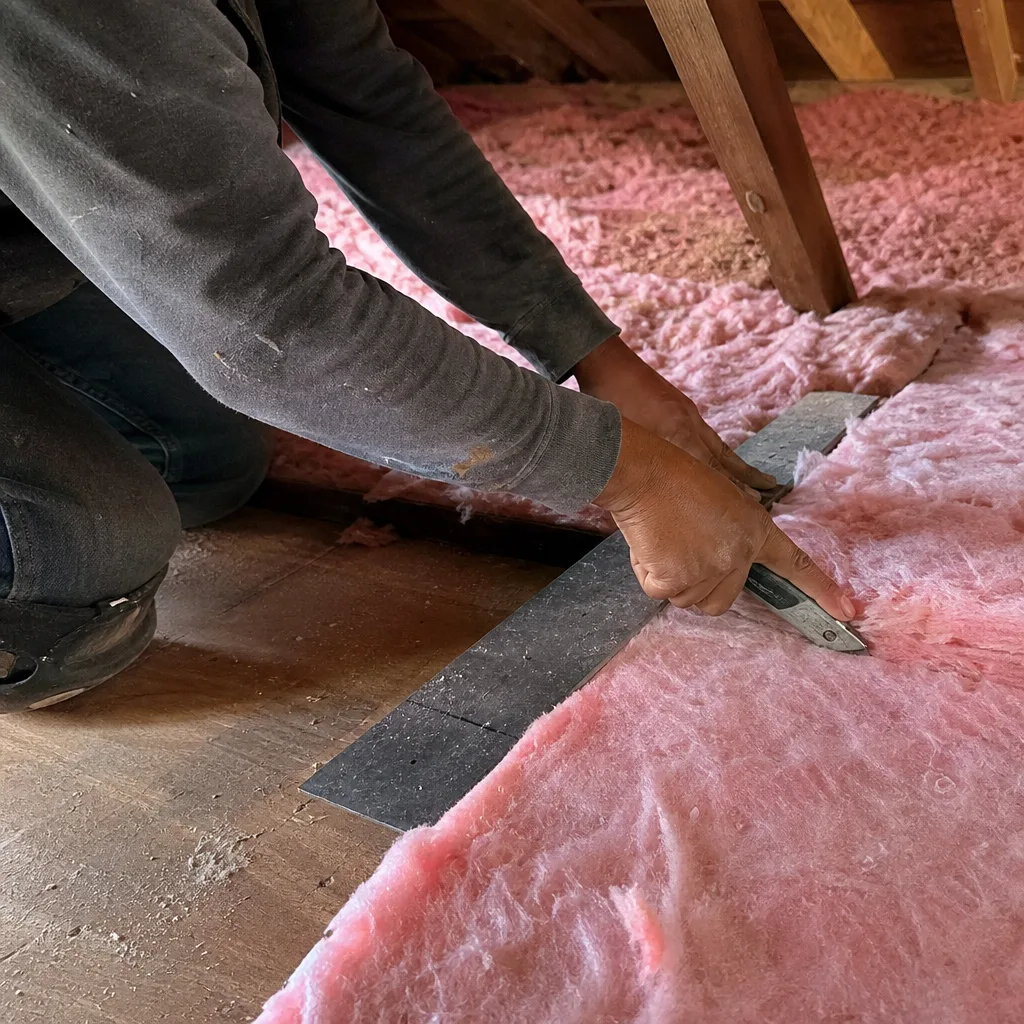
Armadillos, raccoons, squirrels, and roof rats are active attic visitors in Canyon Lake’s wooded, rocky terrain. They don’t just tear things up; they create compression channels, paths of packed-down insulation where they repeatedly travel between entry point and nesting area. These channels are easy to miss if you’re looking for “damage” rather than subtle topographical changes in the insulation surface.
What to look for: Linear depressions 4-8 inches wide, running between soffit gaps, gable vents, or roof penetrations and warmer areas near HVAC ducts or chimney flues. The insulation on either side of the channel may read normal depth; the channel itself reads 50-70 percent low. Look for accompanying signs: droppings, urine crystallization (white, chalky residue on rafters), or hair caught on nail points.
Why re-fluffing fails: We’ve seen homeowners in Canyon Lake spend weekends raking insulation back to full depth, only to find the channels recompressed within a single season. The wildlife entry point remains open. Without air sealing that gap with rigid materials, not just spray foam that animals chew through, the traffic pattern reestablishes immediately. Re-fluffing without exclusion is maintenance theater.
The correct sequence, which we document on every attic insulation in Canyon Lake job that involves wildlife damage:
- Identify all entry points with a thorough attic perimeter inspection, including roofline gaps where fascia meets decking.
- Seal entry points with galvanized steel mesh, hardware cloth, or rigid metal flashing, depending on gap size and location. Spray foam alone is insufficient; animals chew through it.
- Remove heavily soiled insulation in the channel zones. Light compression without contamination can sometimes be restored.
- Air seal the attic floor, including top plates and penetrations, before adding replacement insulation. This prevents new scent trails from attracting the next animal.
- Install replacement material to specified depth, with photo documentation at the five measurement points.
GreenFiber cellulose, which we use in some Canyon Lake applications, contains borate treatment that deters insects and provides mild rodent resistance. It’s not a substitute for physical exclusion, but it reduces the attractiveness of the attic as a nesting environment compared to untreated fiberglass.
Soffit-to-Ridge Ventilation Check with an Infrared Thermometer
Attic ventilation in Canyon Lake isn’t about cooling the attic; it’s about moisture control and preventing heat buildup that degrades insulation binders. When soffit baffles, the cardboard or plastic channels that keep insulation from blocking soffit vents, get crushed or omitted, attic temperatures spike and fiberglass binder breakdown accelerates.
You can diagnose this with a $12 infrared thermometer from any hardware store. Here’s the protocol:
- Wait for a sunny afternoon, 2-4 PM, when outdoor temperature is above 85°F. This creates the maximum temperature differential between ventilated and unventilated attic zones.
- Measure attic air temperature at the ridge, near the peak. Record this as your baseline.
- Measure attic air temperature at the soffit, 2 feet in from the eave. In a properly ventilated attic, this should read within 15°F of the ridge temperature. If it’s more than 25°F hotter at the ridge, your soffit intake is choked.
- Measure the insulation surface temperature at mid-attic. Compare to your ridge air temperature. If the insulation surface is more than 10°F hotter than the ridge air, you have a ventilation short-circuit, likely from exhaust fans or duct leaks pressurizing the attic.
- Visually inspect soffit baffles from the attic side. Look for baffles crushed by insulation, baffles that terminate before the soffit vent opening, or complete absence of baffles in retrofit installations.
Blocked soffit baffles are epidemic in Canyon Lake homes where blown insulation was added over original batts without proper prep. The new material fills the soffit cavity, creating a solid plug. We’ve found this condition in roughly 40 percent of homes built between 2005 and 2015 that we’ve audited.
The fix is physical, not chemical: pull back insulation, install or restore baffles, verify clear air path from soffit vent to attic space, then replace insulation to proper depth. On jobs where we perform this work, the before-and-after blower-door numbers typically show improvement even though ventilation isn’t strictly an air-sealing measure; removing the soffit plug eliminates a pressure imbalance that was driving exfiltration through ceiling penetrations.
DIY Depth Check vs. Blower-Door Retest: When to Call
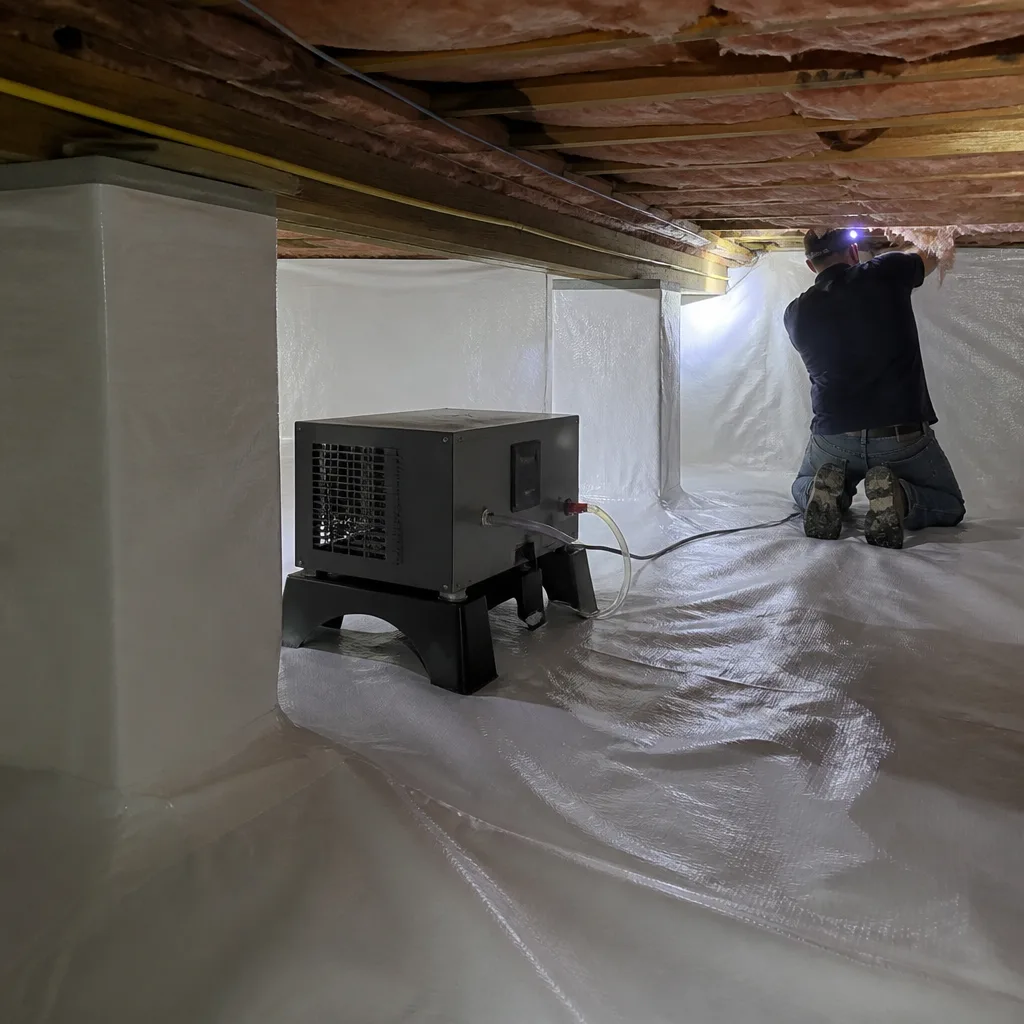
Annual depth measurement is homeowner-level maintenance. A blower-door retest is professional-level diagnostics. Knowing the threshold between them saves you money on unnecessary testing and catches problems that a ruler cannot.
DIY depth check is sufficient when:
- All five measurement points read within 15 percent of original installation depth
- No visible moisture staining, clumping, or wildlife signs
- Energy bills track within 10 percent year-over-year, adjusted for weather
- Home comfort is consistent; no rooms with persistent hot spots in summer or cold spots in winter
A blower-door retest is warranted when:
- Two or more measurement points read more than 20 percent below original depth
- You’ve had any attic work performed by another contractor, HVAC, electrical, roofing, that involved ceiling penetration
- Energy bills have increased more than 15 percent year-over-year without rate changes or occupancy changes
- You feel drafts, smell attic air in living spaces, or see dust accumulation around ceiling fixtures
- Your original blower-door reading was at or above 7.0 ACH50, air changes per hour at 50 pascals of pressure
The ACH50 threshold matters. A home testing at 5.0 ACH50 or below has a relatively tight envelope; incremental air leakage from settling or minor penetrations won’t dramatically change performance. A home at 7.0 ACH50 or above has a loose envelope to begin with, and any additional degradation is amplified. If your original blower-door reading, which Envelope Insulation Co. provides on applicable jobs, was 7.0 or higher, schedule a retest every 3-5 years regardless of other indicators.
What a blower-door retest reveals that a ruler cannot: whether your air sealing, the critical layer beneath the insulation, remains intact. We’ve audited Canyon Lake homes where insulation depth read perfectly but blower-door numbers had doubled due to failed top-plate sealing or new penetrations from recessed lighting retrofits. The insulation was doing its job; the air barrier wasn’t.
A Canyon Lake Annual Maintenance Schedule
Timing matters in this climate. Here’s a schedule that aligns maintenance tasks with Canyon Lake’s seasonal patterns and your own comfort.
March (Pre-cooling season):
- Perform full 5-point depth measurement
- Inspect AC condensate lines and pans for winter damage or algae buildup
- Check soffit baffles with infrared thermometer on first 85°F+ day
- Photograph all measurement points for year-over-year comparison
June (Peak cooling load):
- Walk the attic perimeter during morning cool hours, looking for new wildlife signs
- Check for condensate staining, especially after first sustained 95°F+ week
- Verify bathroom and kitchen exhaust fans terminate properly, not into attic space
September (Post-cooling season):
- Review summer energy bills against prior year
- Re-measure any points that showed degradation in March
- Schedule professional evaluation if bills spiked or comfort degraded
December (Pre-heating season, minimal):
- Quick visual from attic hatch for obvious disturbances
- Check hatch seal and weatherstripping
- Schedule any deferred work before January cold snaps
This schedule assumes a standard vented attic with blown insulation. If you have crawl space encapsulation and vapor barrier in Canyon Lake, your crawl space has its own maintenance protocol that runs on a similar schedule but with different inspection points.
Common Mistakes to Avoid
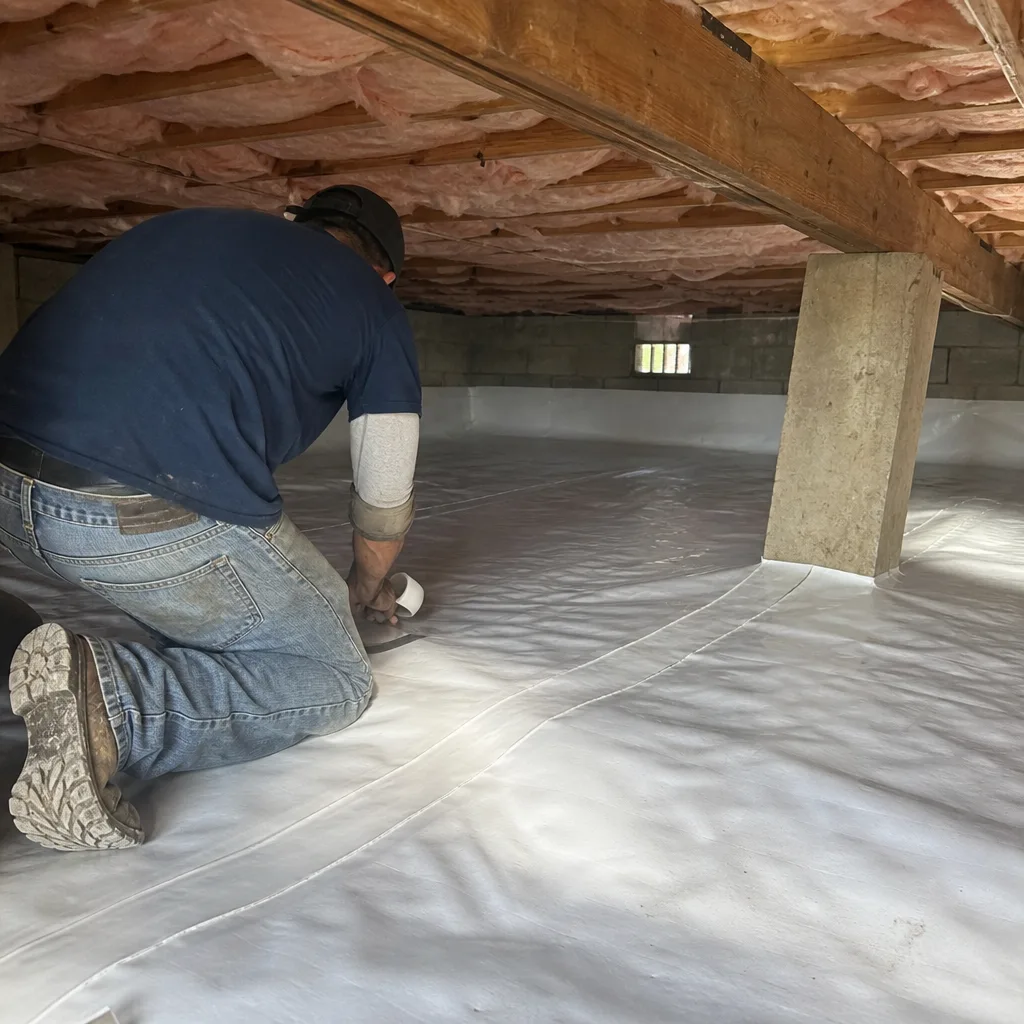
- Measuring at only one point. Attic insulation depth varies by 2-4 inches across a typical Canyon Lake attic due to installation technique, wind washing near eaves, and compaction around penetrations. One measurement gives you false confidence or false alarm.
- Ignoring the air handler platform. The framed platform that supports your AC air handler is a natural thermal bypass; insulation rarely achieves full depth against its vertical sides. Check depth in the narrow gaps around all four sides.
- Re-fluffing compressed cellulose without addressing moisture source. Wet cellulose that has been compressed and dried will not regain its original loft. Re-fluffing creates temporary volume that collapses again within weeks. Remove and replace contaminated material.
- Blocking soffit vents with additional insulation. We’ve seen Canyon Lake homeowners add loose-fill over existing batts to boost R-value, inadvertently burying soffit vents. The attic gets hotter, binder degradation accelerates, and the new material underperforms within seasons.
- Trusting visible surface appearance. Fiberglass especially can look fluffy on top while being compacted and degraded beneath. Your ruler penetrates the full depth; your eyes don’t.
- Delaying professional evaluation after wildlife entry. Animal urine soaks through insulation to the drywall below. The insulation may dry and look normal, but odor and bio-contamination persist. Replacement, not restoration, is the correct response.
- Assuming spray foam is maintenance-free. Open-cell Icynene can absorb moisture if the roof deck leaks; closed-cell Demilec can delaminate from substrates in extreme heat cycling. Annual visual inspection catches these issues early.
When to Call a Professional
Call for professional evaluation when your five-point measurement shows two or more locations below minimum depth for your target R-value, when you find moisture staining or clumping you cannot trace to a resolved source, or when wildlife compression channels are accompanied by entry points you cannot safely access. A blower-door retest is warranted when your original ACH50 was 7.0 or above, or when energy bills have increased more than 15 percent year-over-year.
Topside Attic Insulation Canyon Lake offers free estimates in Canyon Lake. We’ll bring your original blower-door numbers if we performed the work, measure current depths against your documented baseline, and give you a written scope and written price before any work starts. Call (737) 227-6219. If you have a competing estimate, we’ll read it with you, no charge.
Frequently Asked Questions
Perform the full 5-point depth measurement and visual inspection once per year, ideally in March before cooling season ramps up. Check for condensate issues quarterly during summer months, and do a quick visual from the hatch in December. Homes near the lake with higher humidity, or homes with mature trees and active wildlife, benefit from twice-annual full inspections.
Current IECC code for Climate Zone 2 calls for R-30 minimum in attics, with R-38 to R-49 recommended for optimal cooling-season performance. Most Canyon Lake homes built after 2015 were originally insulated to R-38. If your home predates 2010, it may still be at R-19 or R-22, which is significantly below modern standards and worth upgrading when you replace roofing or HVAC equipment.
Yes, if the old insulation is dry, uncontaminated, and not compressed below recoverable loft. No, if there’s moisture damage, wildlife soiling, or significant compression from foot traffic. The new material must also be compatible; loose-fill cellulose over fiberglass batts works, but the batts should be unfaced and the attic should be air sealed first. Adding insulation over an unsealed attic floor, which is what most contractors do, wastes 15-30 percent of the new material’s performance.
Musty odor typically indicates active moisture on wood surfaces, not necessarily visible insulation damage. In Canyon Lake, this often traces to bathroom exhaust fans venting into the attic rather than through the roof, AC condensate pan overflow, or roof leaks that haven’t yet saturated the insulation bulk. The smell means mold or mildew is growing on rafters, sheathing, or the top of the drywall. Professional inspection with moisture meters and possibly air sampling is warranted.
DIY depth checking costs nothing but your time and a $5 ruler. Professional evaluation, including blower-door testing if applicable, typically runs between $200 and $400 in the Canyon Lake market. If work is needed, most attic insulation restoration or top-off jobs in homes of 1,800 to 2,800 square feet range from $1,800 to $4,200 depending on material type, accessibility, and whether air sealing or wildlife exclusion is included. Call (737) 227-6219 for an exact quote on your specific attic; estimates are free and come with a written scope before any work starts.
Repair, meaning targeted addition of material to depleted zones, is cheaper upfront but often more expensive over five years if the underlying cause, air leaks, moisture, wildlife entry, isn’t resolved. Replacement with proper air sealing and documented blower-door verification costs more initially but delivers measurable, guaranteed performance. For Canyon Lake homes with insulation older than 15 years, replacement with modern materials and sealing typically pays back in 4-7 years through reduced cooling load. Call (737) 227-6219 and we’ll run the numbers for your specific situation.
Documented energy performance improves marketability more than insulation alone. A Canyon Lake home with before-and-after blower-door numbers, a written scope from a recognized contractor, and a transferable warranty like our 365-Day Done Right Promise stands out in disclosure packets. Buyers in the 32-50 age bracket, who research thoroughly, specifically look for documentation over claims. Insulation without documentation is invisible; insulation with verified performance is a selling point.
The Bottom Line
Attic insulation maintenance in Canyon Lake is not a visual check from the hatch. It’s five measured depth points, specific knowledge of what moisture damage looks like in high-humidity conditions, wildlife compression channel identification, and ventilation verification with simple tools. The homeowners who get this right catch performance degradation early, before it becomes replacement. The ones who don’t find out when their summer electric bill jumps 30 percent or a home inspector flags depleted insulation at sale. Document your baselines, measure annually, and know when a ruler is enough versus when a blower-door retest tells the real story. For more guides & resources on attic care in this climate, explore our blog.
Written by Wes Okafor, Owner at Topside Attic Insulation Canyon Lake, serving Canyon Lake since 2016.